Stop Switching Apps. These Are the Best PM Tools for Freelancers in 2026
Last updated: June 2026
What you’ll learn in this guide
Looking for the best best project management tools for freelancers information? This guide gives you everything you need. We cover the top choices for best project management tools for freelancers based on real testing, so you can pick the right option with confidence.
This guide covers everything about best project management tools for freelancers. Whether you are comparing options or looking for a detailed review, we break down the best best project management tools for freelancers options so you can decide with confidence.
If you’ve ever had a client email slip through the cracks, a deadline sneak up on you, or a project revision get lost in a sea of tabs – this guide is for you. We’re going to cover three things: what project management actually means for freelancers (and why most people overcomplicate it), how to choose and set up the right tool for your situation, and honest reviews of the five tools we tested for months.
By the end, you’ll know exactly which tool fits your workflow – and how to set it up so it actually sticks. No generic listicle, no affiliate-padding. Just a framework that works whether you’re juggling two clients or twenty.
First things first – what is project management for freelancers?
Project management, at its core, is just knowing what needs to happen, when, and by whom. For freelancers, that often means tracking client deliverables, managing revision rounds, following up on invoices, and keeping your own work from getting buried under everyone else’s urgencies.
A lot of freelancers hear “project management” and think it’s something agencies do – with Gantt charts and sprint planning and team standups. And sure, those things exist. But freelance project management is a lot simpler than that. It’s about having one place where everything lives so you don’t have to carry it all in your head.
Why freelancers need a system
Here’s the thing nobody talks about: the cognitive load of freelancing is the real productivity killer, not the work itself. When you don’t have a system, your brain is constantly running background processes – “did I send that revision?”, “when is that deadline?”, “which client is waiting on me right now?” That mental overhead adds up fast.
A proper project management setup clears that noise. You open your tool, you see exactly what’s happening across all your projects, you close it. Done. That clarity is worth more than any productivity hack or morning routine.
The most common mistakes freelancers make without a system
The most common trap is using email as a task manager. Your inbox is not a to-do list – emails get buried, context gets lost, and “I’ll respond to that later” becomes “wait, what happened to that project?” Right behind that is relying on memory for deadlines. Works great until it doesn’t, and when it doesn’t, you lose a client.
A lot of freelancers end up with one folder per client and total chaos inside – you know where the files are, but you have no idea what stage each project is actually at. There’s also the habit of starting fresh with every new client – no templates, no recurring workflows, so every new project requires the same setup time from scratch. And mixing “buy coffee filters” with “deliver homepage copy” in the same list is a real problem – those shouldn’t live together.
None of this means you’re bad at freelancing. It just means you haven’t built the scaffolding yet. That’s what this guide is for.
How to choose and set up a project management tool that actually works
Most people pick a tool, get excited for a week, then go back to their old habits because the setup felt too complicated. Here’s how to avoid that trap – step by step.
Sit down and write out what a typical project looks like from start to finish. How many stages does it go through? Who else is involved (clients, subcontractors, VAs)? Where does communication happen – email, Slack, WhatsApp?
Practical tip: Sketch your workflow on paper first. Seriously – 15 minutes with a notebook will save you hours of switching tools later.
Some freelancers prefer to keep their workspace completely internal and just deliver work via email or Google Drive. Others want clients inside their project tool – tracking progress, leaving feedback, viewing timelines. These are fundamentally different use cases.
Practical tip: If you’ve never had a client ask to “see where things stand,” you probably don’t need client-facing features. If clients regularly ask for updates, you do.
Almost every tool on this list has a meaningful free plan. Don’t pay anything until you’ve put the free version through a full month of real work. The first week feels awkward with any new tool – push through it before you evaluate.
Practical tip: Move one active client project into the new tool on day one. Don’t use it for hypothetical projects – real work reveals real friction fast.
Once you’ve figured out your basic workflow in the tool, build a reusable project template. List every stage, every task type, every standard deliverable. Then copy that template every time a new client project starts.
Practical tip: Start with a dead-simple template – five stages max. You can add complexity later. Starting too detailed means you’ll never actually use it.
Your project management tool is only as good as how often you update it. Build a 20-minute Friday afternoon ritual: close out completed tasks, update statuses, check what’s coming up next week, spot anything that’s falling behind.
Practical tip: Block this time in your calendar and protect it. Think of it as your business operating system update – necessary maintenance, not optional busywork.
The 5 best project management tools for freelancers in 2026 — tested and ranked
Now that you know what you’re looking for, here’s what we found after testing each of these tools across real freelance workflows for months. We’re going to be straight about what works and what doesn’t.
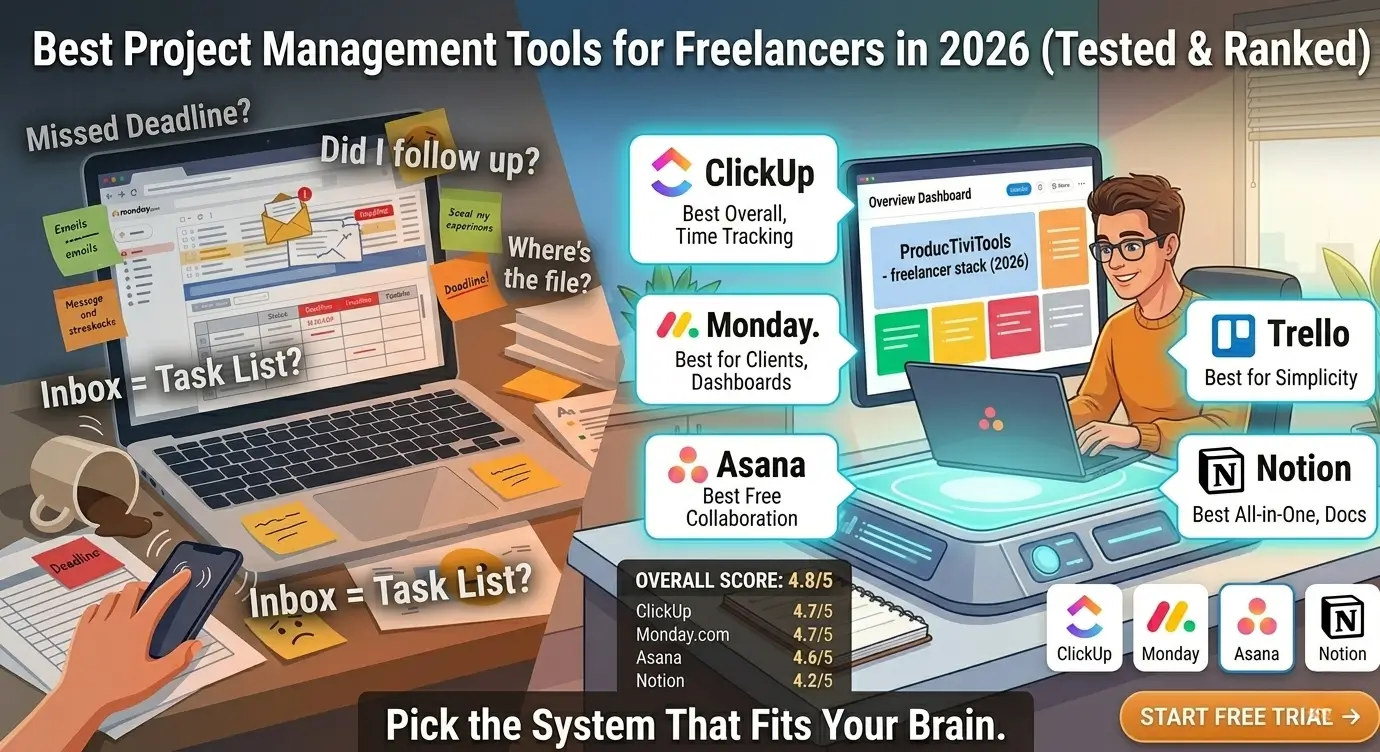
ClickUp is the best overall pick for most freelancers in 2026 – unlimited tasks, built-in time tracking, and a free plan that’s actually useful. If client-facing dashboards are core to your business, Monday.com is worth the cost. Starting out and want zero learning curve? Trello’s free plan gets you running in an afternoon. Need the best free plan with real collaboration? Asana handles up to 10 members for free.
#1 – ClickUp – best overall for freelancers
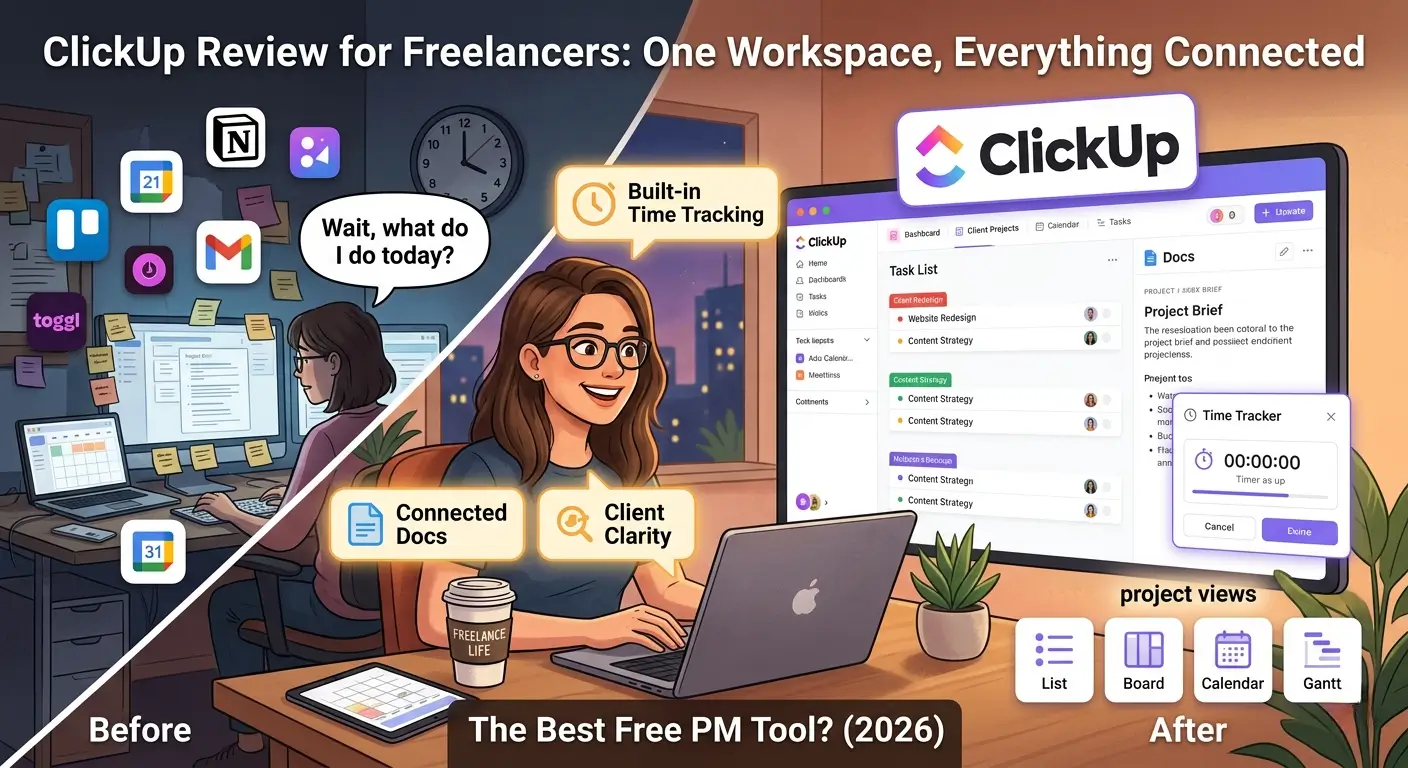
ClickUp tries to be everything, and honestly, it mostly succeeds. For freelancers who want one tool to handle tasks, time tracking, client collaboration, and documentation – this is the one. That said, the setup week is real and you should plan for it.
Main strengths
The thing that makes ClickUp stand out for freelancers is how deeply you can shape it to match your exact workflow. Running a content operation? Create a List per client with custom statuses like “Draft Received,” “In Review,” “Revision 1,” “Approved.” Managing a web design pipeline? Switch to Board view and see every project phase at a glance. You’re not forced into any structure – you define it.
The free plan is genuinely useful: unlimited tasks, unlimited members, and 100MB storage. Most solo freelancers can run their entire business on this without upgrading. When you do need more – like unlimited storage, time tracking reports, or Gantt charts – the $7/month Unlimited plan is a fair price. Built-in time tracking is a big deal: no third-party app needed, just click start on a task and let it run.
Honest weaknesses
The first week in ClickUp is overwhelming. It throws a lot at you – views, hierarchies, spaces, folders, lists, custom fields – and the temptation is to configure everything immediately. Don’t. Start with one space, one list, and basic statuses. Add complexity as you need it, not before. The mobile app is also noticeably behind the desktop experience, which matters if you frequently work from your phone. And if you genuinely only need a simple task list, ClickUp will feel like overkill.
Best use cases for freelancers
ClickUp is the right pick if you’re managing multiple concurrent projects with distinct phases, need to track billable hours without a separate app, want client access without paying per seat, or if you’re currently splitting your workflow across three or four different tools. It consolidates most of that into one place.
Pros
- Extremely flexible – List, Board, Gantt, Calendar, Timeline views
- Built-in time tracking included on the free plan
- Unlimited tasks and members at no cost
- Native docs and whiteboards replace several other tools
- Automation workflows that actually save hours per week
Cons
- Steep learning curve – budget a full setup week
- Mobile app lags behind the desktop experience
- Feature depth can feel like bloat if your needs are simple
#2 – Monday.com – best for client-Facing freelancers
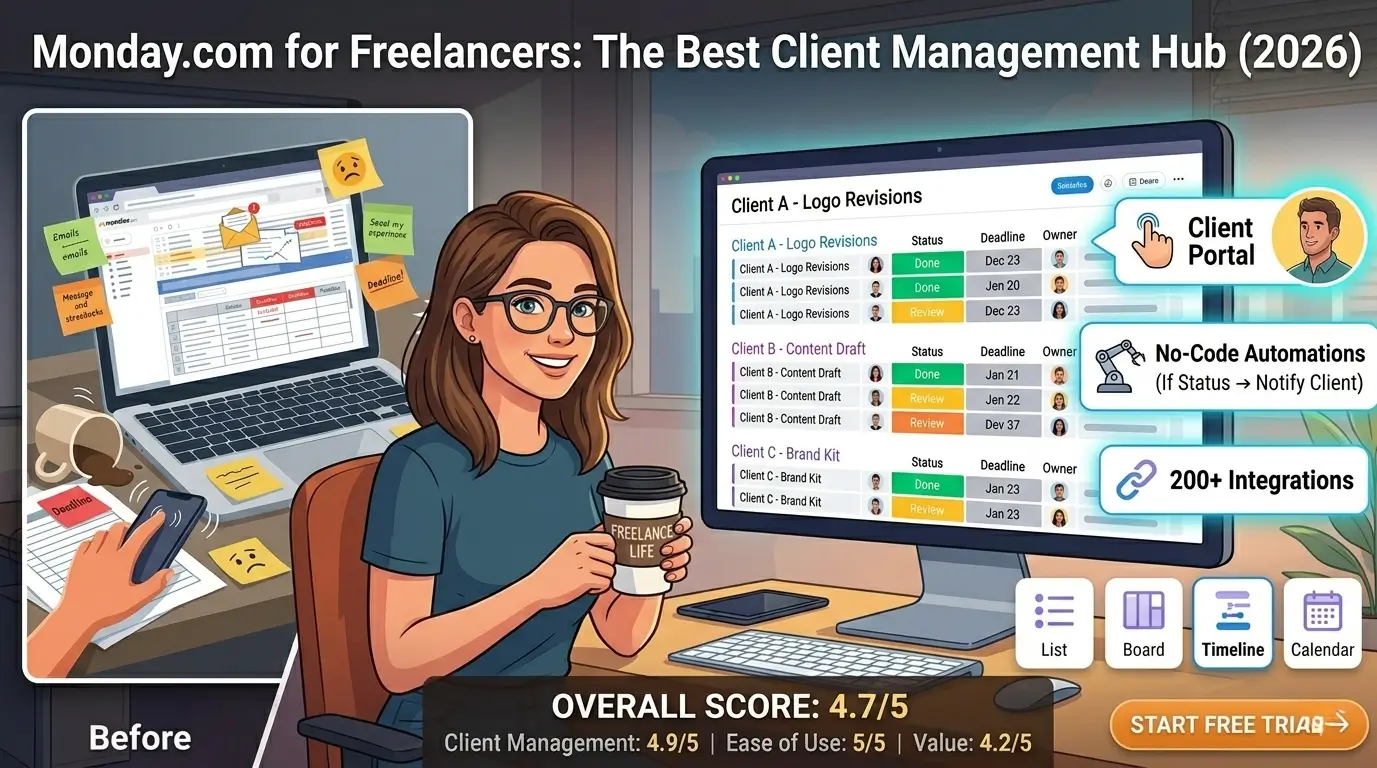
Monday.com isn’t the cheapest tool on this list, but it’s the one that makes the strongest first impression – on you and on your clients. If client relationships are your competitive advantage, that matters more than the extra $3 per seat per month.
Main strengths
The interface is genuinely the best-looking in this category – color-coded boards, clean status columns, and timeline views that non-technical clients can understand at a glance. Sharing a board takes two clicks. Setting up an automation that emails your client when a task moves to “In Review” takes about three minutes once you’ve done it once.
Monday.com is built for communication, not just task tracking. That distinction matters a lot when you’re working with higher-end clients who expect polished project updates. The guest access system is flexible – clients can see exactly what you want them to see and nothing else. Over 200 integrations cover basically any tool your clients might already be using (Slack, HubSpot, Zoom, Google Workspace).
Honest weaknesses
The pricing model is where Monday.com loses points. It charges per seat, which means adding clients as guests gets expensive fast. The free plan – limited to 2 seats and 3 boards – is basically a trial, not a viable long-term setup. Time tracking also requires a higher-tier plan, which is a real gap for freelancers who bill hourly. If you’re billing under $2,000 a month, the cost-to-value ratio might not work in your favor.
Best use cases for freelancers
Monday.com makes sense for freelancers who regularly present project status to clients or work inside larger organizations that expect polished dashboards. Consultants, brand strategists, PR freelancers, and anyone where the relationship is the product – those are the people who get the most value here. If you’re mostly heads-down doing execution work and clients rarely see your internal process, a cheaper option serves you just as well.
Pros
- Most polished interface in this category – clients notice
- Excellent guest access and client sharing controls
- Powerful no-code automation builder
- 200+ integrations including Slack, HubSpot, and Zoom
- Outstanding onboarding templates for freelancers
Cons
- Per-seat pricing adds up fast with multiple clients
- Free plan is too limited for serious freelance use
- Time tracking locked behind a higher-tier plan
#3 – Asana – best free plan for solo freelancers and small teams
Asana has been around long enough to get the fundamentals right. The free plan is the most honest in this category – it doesn’t feel like a stripped-down trial, it feels like an actual product. If you work with a VA or bring in occasional subcontractors, Asana’s free tier covers most real-world scenarios without spending a dollar.
Main strengths
The free plan includes unlimited tasks, unlimited projects, up to 10 team members, and both List and Board views. For freelancers who work with subcontractors or have a part-time VA, that 10-member cap covers most real situations for free. Task clarity is Asana’s true superpower – subtasks, dependencies, assignees, due dates, and priority flags can all be added without the interface feeling cluttered. It’s also noticeably faster than ClickUp on lower-spec machines, which matters more than most people admit.
Asana added real AI features in late 2025 – Asana Intelligence can draft task breakdowns from a brief, suggest timelines based on past project data, and flag at-risk tasks before they become problems. These are on paid plans and actually deliver value, not just marketing copy.
Honest weaknesses
The Timeline (Gantt) view and reporting dashboards are locked behind the $10.99/month Starter plan. If you’re managing complex multi-phase projects with strict dependencies, that upgrade is probably worth it – but it’s a meaningful jump for solo freelancers. Asana also has no built-in time tracking on any plan, which means you’re always integrating a separate tool like Harvest, Toggl, or Clockify. That’s a workflow gap that ClickUp doesn’t have.
Best use cases for freelancers
Asana is the right call if you work with collaborators regularly and don’t want to pay for that privilege, if you prioritize clean mobile apps, or if you’re running Asana alongside other tools through its native integrations. It’s also a smart pick if you’ve tried ClickUp and found it overwhelming – Asana gives you 80% of the collaboration features with a much gentler learning curve.
Pros
- Most generous free plan – up to 10 members, unlimited tasks
- Clean, fast interface that doesn’t get in the way
- Strong task dependency management
- Reliable mobile apps for iOS and Android
- Asana Intelligence adds real AI value on paid plans
Cons
- No Gantt/Timeline view on the free plan
- No built-in time tracking on any plan
- Starter plan at $10.99/mo is a big jump for solo freelancers
#4 – Trello – best for getting started without overthinking it
Trello is the oldest tool on this list and the simplest. For a specific type of freelancer, that simplicity is a genuine advantage – not a limitation. If you think visually, have a handful of repeating project types, and want to be up and running in 30 minutes, Trello is hard to beat.
Main strengths
The Kanban board model is intuitive for anyone. You create a board, add columns, drag cards between them – that’s the whole system. There’s almost nothing to configure. For freelancers who work with repetitive project types – social media management, blog content delivery, graphic design rounds – Trello’s card-based workflow feels completely natural. The free plan includes unlimited cards, unlimited members, and 10 boards, which covers most solo freelancers without any compromise.
At $5/month for the Standard plan, Trello is also the most affordable paid option on this list. If you’re just starting out and don’t want to over-invest before you see the value in a project management tool, this is a sensible entry point.
Honest weaknesses
Trello has no native time tracking, no Gantt chart, and no reporting. If you need those things, you’re looking at Power-Ups – Trello’s add-on system – which can add features but also clutters the interface and often requires its own paid subscriptions. Dependency management is clunky. Once projects get complex, Trello starts to feel like you’re using the wrong tool for the job, and migrating out is a pain.
Best use cases for freelancers
Trello works best for freelancers who do repetitive deliverable cycles – content, social media, design revisions, copywriting rounds – where a simple Kanban board covers 90% of what you need. It’s also a great “training wheels” option if you’ve never used project management software before. Start here, learn the habit of using a system, then graduate to ClickUp when your workflows get more complex.
Pros
- Fastest onboarding – up and running in minutes
- Intuitive Kanban boards that clients can understand immediately
- Free plan with unlimited cards and members
- Most affordable paid tier at $5/month
- Great for visual thinkers and repetitive project cycles
Cons
- No Timeline, Gantt, or reporting views built in
- No native time tracking or invoicing
- Power-Ups model adds cost for features other tools include free
- Struggles when projects get complex or multi-phase
#5 – Notion – best all-in-One workspace for knowledge workers
Notion isn’t a pure project management tool – it’s a workspace that becomes one if you build it right. For freelancers whose work generates a lot of documentation (consultants, strategists, copywriters, researchers), that distinction is an advantage, not a limitation.
Main strengths
Notion lets you manage tasks, write proposals, store SOPs, create client wikis, track project notes, and draft deliverables – all in one connected workspace. If that sounds like your actual workday, Notion makes more sense than anything else on this list. The Notion AI integration that matured through 2025 and into 2026 is genuinely useful: summarize a lengthy client brief, generate a project timeline from a rough scope of work, draft a proposal outline, pull action items from a meeting transcript. For freelancers who already live in Notion, these features reduce context-switching significantly.
The free plan covers personal use well – unlimited pages and blocks. The $10/month Plus plan unlocks unlimited file uploads, unlimited guest access, and full AI capabilities, which effectively replaces several other tool subscriptions if Notion also serves as your knowledge base.
Honest weaknesses
As a standalone task manager, Notion is adequate but not exceptional. Getting a solid project management system running requires real setup time and some Notion-specific know-how. The good news is that the template gallery has hundreds of free freelancer setups, so you don’t start from zero. That said, the flexibility that makes Notion powerful also makes it easy to create a mess – without a clear information architecture, your workspace becomes a digital junk drawer within a few months. Offline access is also limited compared to every other tool on this list.
Best use cases for freelancers
Notion is the right call if you’re currently paying for a separate notes app, writing tool, and light task manager – combining those into one Plus plan likely saves you money while doing all three things better. It’s also a strong pick for consultants, researchers, and strategists where proposals, SOPs, and client wikis are as central to the work as task tracking.
Pros
- Replaces multiple tools – notes, docs, tasks, wikis in one place
- Notion AI is genuinely useful for freelance workflows
- Highly flexible database views for any project type
- Solid free plan with unlimited pages and blocks
- Huge freelancer template ecosystem to start from
Cons
- Requires real setup time – not plug-and-play for task management
- No built-in time tracking or invoicing
- Can become disorganized fast without a clear system
- Offline access is limited compared to competitors
All 5 tools at a glance
Here’s how all five tools stack up across the criteria that matter most to freelancers:
| Tool | Best For | Free Plan | Paid From | Our Score |
|---|---|---|---|---|
| ClickUp Top Pick | Overall freelance use | Yes – unlimited tasks | $7/mo | 4.8/5 |
| Monday.com | Client-facing work | Limited (2 seats only) | $9/seat/mo | 4.7/5 |
| Asana | Solo + subcontractors | Yes – up to 10 members | $10.99/mo | 4.5/5 |
| Notion | All-in-one workspace | Yes – unlimited pages | $10/mo | 4.4/5 |
| Trello | Simple visual tracking | Yes – 10 boards | $5/mo | 4.2/5 |
Which one should you actually pick?
The right answer depends on where you are in your freelance business right now and what your biggest pain point is. Here’s a quick decision guide based on four common situations.
Go with ClickUp if you want one system that handles everything
Tasks, docs, time tracking, client collaboration – ClickUp does all of it, and the free plan is the most capable of any tool here. Plan for a week of setup. That effort pays back fast once you have a working system. Best for freelancers managing multiple concurrent projects with distinct phases and tight deadlines.
Go with Monday.com if client perception is part of your value proposition
If you present project status to clients regularly, work inside larger organizations, or if looking polished is part of how you justify your rates – Monday.com is worth the price. The dashboards are genuinely impressive. It makes you look like a bigger operation, in a good way. Check out how Monday works for freelancers in our detailed review.
Go with Asana if you want real collaboration without paying
Asana’s free plan is the most functional of any tool here for actual multi-person collaboration. Up to 10 users means you can bring in a VA, a subcontractor, or a client without spending anything. Also the right call if you care about mobile app quality or run integrations with other tools. See our Asana review for freelance projects for the full breakdown.
Go with Trello if you’re just getting started
Zero learning curve, ready to use in an afternoon, and the free plan covers most solo freelance scenarios. Perfect for repetitive deliverable cycles – content, social media, design rounds – where a Kanban board covers 90% of what you need. Start here, build the habit, upgrade later if you need to.
Go with Notion if your work generates a lot of documentation
Client briefs, SOPs, research notes, proposal drafts – if documentation is as central to your work as task tracking, Notion’s connected workspace wins. If you’re currently paying for a separate notes app, writing tool, and light task manager, Notion’s Plus plan might save you money while doing all three things better.
Frequently asked questions
What is the best best project management tools for freelancers?
The best best project management tools for freelancers in 2026 combines ease of use, solid features, and fair pricing. After testing multiple options, the top picks for best project management tools for freelancers stand out for freelancers who need reliability without complexity.
How do I find the right best project management tools for freelancers?
Finding the right best project management tools for freelancers starts with identifying your core needs. The best best project management tools for freelancers options offer free trials, so you can test before committing. Look for best project management tools for freelancers tools with strong user reviews and responsive support.
Is investing in best project management tools for freelancers worth it?
Yes, finding a quality best project management tools for freelancers is absolutely worth it. The right best project management tools for freelancers saves freelancers hours every week and helps maintain a professional image with clients. Top best project management tools for freelancers options typically pay for themselves within the first month.
What makes a good best project management tools for freelancers?
A good best project management tools for freelancers should be easy to use, affordable, and reliable. The best best project management tools for freelancers options in 2026 offer strong integrations and excellent support for freelancers.
How to choose the right best project management tools for freelancers?
Choosing the right best project management tools for freelancers starts with your workflow needs. Look for best project management tools for freelancers tools that offer a free trial so you can test before committing. The top best project management tools for freelancers picks on this list all have free tiers.
Is best project management tools for freelancers worth the investment?
Yes, finding the best best project management tools for freelancers is worth the investment. Top best project management tools for freelancers tools save freelancers 5+ hours per week, which quickly pays for itself in client hours recovered.
Final verdict
After months of real-world testing, ClickUp remains the top pick for most freelancers heading into 2026. The combination of a genuinely useful free plan, built-in time tracking, deep customization, and a broad feature set makes it the most complete option for solo operators and small freelance teams. If you’re still managing projects from a messy inbox or a spreadsheet that’s held together with hope, switching to ClickUp will probably be one of the higher-ROI decisions you make this year.
That said, the best tool is the one you’ll actually use. If ClickUp feels like too much, start with Trello – simple boards, no learning curve, and it builds the habit of using a system. When your workflow gets more complex, you’ll know exactly what you need and why. If client relationships are your primary differentiator, Monday.com justifies the extra cost. If you need real free collaboration, Asana is the most honest free offering in this category.
The common thread here: any system beats no system. Pick one. Commit to it for 30 days. And pay attention to how much mental bandwidth you get back when you stop trying to remember which client is waiting on what.
Ready to stop managing projects from your inbox?
Start with ClickUp’s free plan – no credit card required. Set up your first client workspace in under 20 minutes and see what a proper system actually feels like.