Monday.com Review: Powerful Tool or Overkill for Solo Freelancers?
Last updated: June 2026

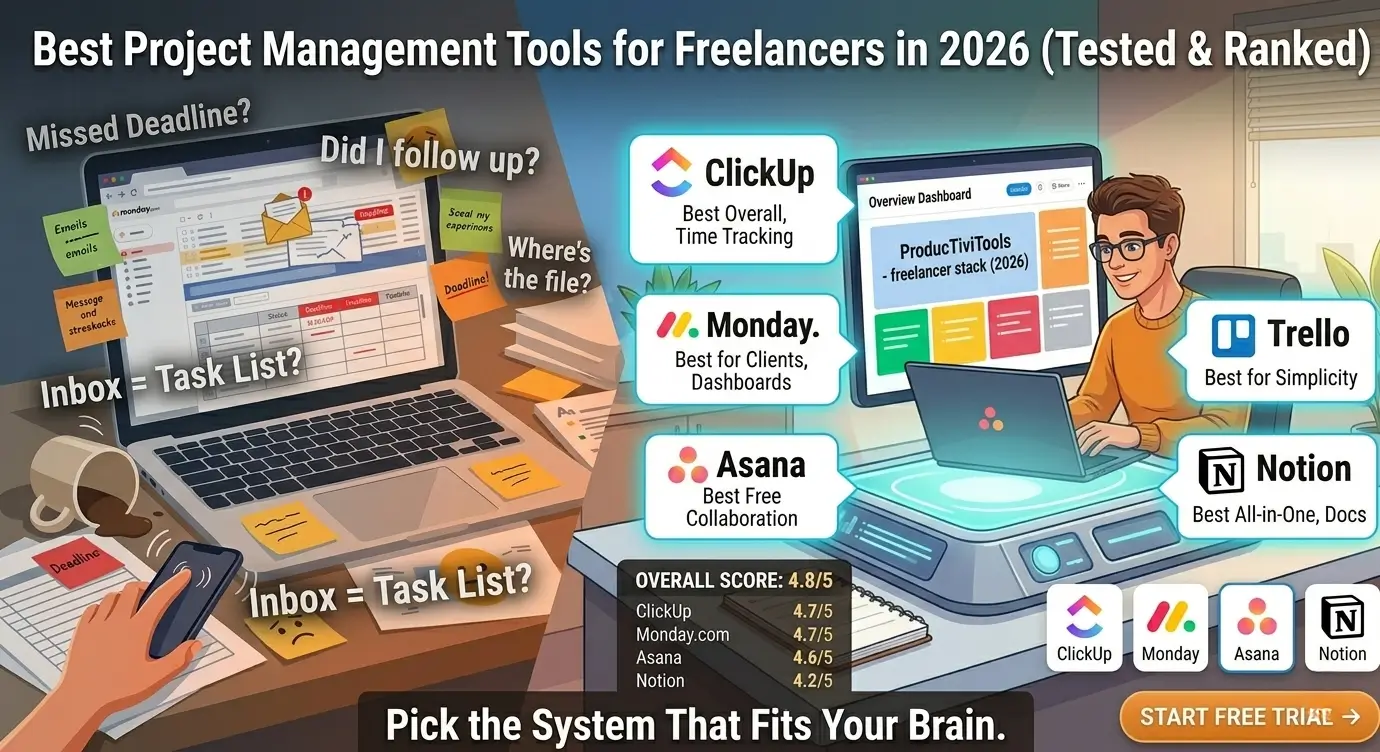
It was a Wednesday evening. A freelance designer we know got a message from a client: “Hey, wasn’t the logo revision supposed to be ready today?” She scrolled through her inbox, then her notes app, then a spreadsheet she hadn’t updated in two weeks. The task was there – buried under three email threads and a sticky note that had somehow ended up in the wrong folder. She missed the deadline. Not because she forgot the work existed, but because she had absolutely no system to see everything at once.
That one missed deadline cost her the follow-up project. That’s what happens when you’re managing clients out of your inbox.
Before – managing clients out of your head
Looking for the best monday.com review for freelancers information? This guide gives you everything you need. We cover the top choices for monday.com review for freelancers based on real testing, so you can pick the right option with confidence.
This guide covers everything about monday.com review freelancers. Whether you are comparing options or looking for a detailed review, we break down the best monday.com review freelancers options so you can decide with confidence.
If you’re juggling two, three, or four clients at once, you know the feeling. Every client lives in a different place – their project in your inbox, their feedback in a Google Doc, their deadline on a sticky note by your monitor. You build a mental map of everything outstanding and you update it constantly, in real time, from memory. It works until it doesn’t.
The problem isn’t that you’re disorganized. It’s that you’re using tools designed for individual tasks to manage something much bigger – an entire business with multiple moving parts. Spreadsheets and email threads aren’t broken. They’re just not built for this. When a client slips through the cracks, it’s rarely laziness. It’s a systems failure masquerading as a personal one.
Most freelancers respond by adding more tools – a separate app for each client, a calendar plugin, a task manager on the side. But more tools usually means more to maintain, more to fall out of sync, and more places for things to get lost. The chaos doesn’t go away. It just gets more expensive.
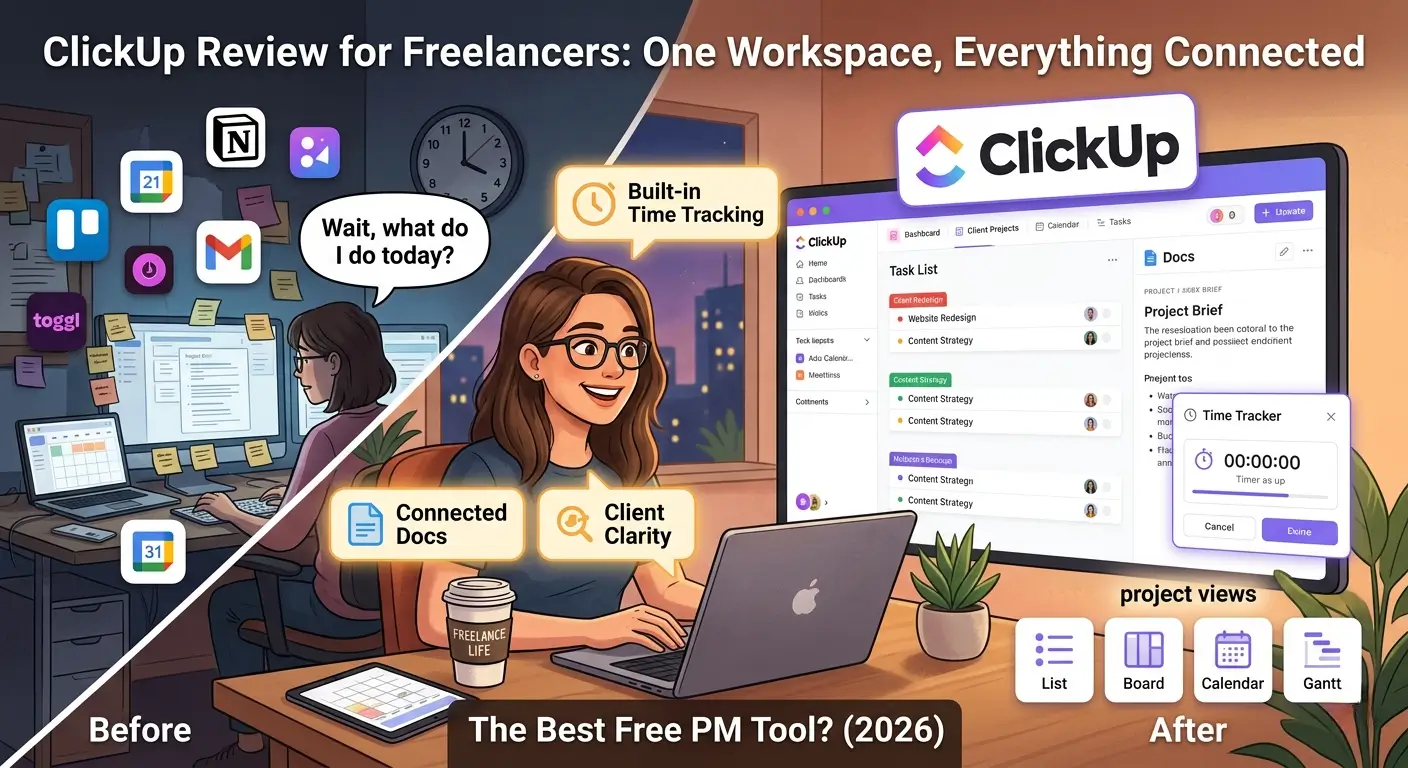
After – one board, every client, full clarity
Now picture opening a single app on Monday morning and seeing everything – every client, every active project, every upcoming deadline – laid out on a clean visual board. Your content client’s article draft is due Thursday. The brand redesign is in review. The consulting deck goes out Friday. Everything is color-coded, status-updated, and sorted by deadline. No mental inventory. No inbox archaeology. You know exactly where things stand before you’ve had your second coffee.
That’s not a fantasy. That’s a properly set up Monday.com workspace. And getting there takes less than a morning.
Enter Monday.com: honest Monday.com review for freelancers
Monday.com launched back in 2012 as a smarter alternative to the project spreadsheet. By 2026 it’s grown into what the company calls a “Work OS” – a flexible platform where you build workflows without writing a single line of code. Over 225,000 organizations use it, from Coca-Cola to individual freelancers who manage three clients from a home office.
What makes Monday.com interesting for freelancers isn’t that it’s enterprise software – it’s that it doesn’t feel like it. The onboarding is genuinely friendly. The interface is drag-and-drop and color-coded from day one. You can be managing real client projects within the first hour, not the first week. If you’ve bounced off other PM tools because the learning curve felt too steep, Monday.com is the one most likely to actually stick.
Monday.com is the most polished and client-friendly PM tool for freelancers in 2026. The interface is genuinely easy to use, the client portal is in a category of its own, and automations work without any technical knowledge. The real catch: there’s no free plan, and all paid plans require a minimum of 3 seats – so even as a solo freelancer, you’re paying at least $27/month. If you manage multiple clients and want to look professional doing it, that’s easy to justify. If you’re a one-client freelancer on a tight budget, there are better options starting at zero.
out of 5
Pros
- Most intuitive interface of any PM tool we tested
- Board, timeline, calendar, and list views all included
- Client portal lets clients track progress without a login
- Automations work without any technical knowledge
- 200+ integrations including Slack, Google Drive, Zapier
- 14-day free trial, no credit card required
Cons
- No free plan (starts at $9/seat/mo billed annually)
- Minimum 3 seats on all paid plans
- Less customization depth than ClickUp
- Time tracking locked behind the Pro plan
Real experience – what using Monday.com actually looks like
We ran Monday.com through 60 days of real freelance work across three different profiles – a content writer with three editorial clients, a UX designer tracking deliverables through a product redesign, and a marketing consultant juggling campaign timelines and monthly check-ins. In each case, we started from the free trial and built a fresh workspace from scratch.
Setup – faster than you’d expect
Monday.com’s onboarding asks a few questions about what kind of work you do, then pre-builds a template workspace based on your answers. For the content writer, it spun up an editorial calendar with columns for client name, content type, due date, and status – almost exactly what she would have built herself. Tweaking it to fit her actual workflow took about 25 minutes. That kind of smart starting point matters when you’re evaluating tools and don’t want to stare at a blank screen.
Connecting integrations was equally painless. Slack, Google Drive, and Google Calendar were all live within the first session. If you already live inside those tools, Monday.com slots in without disrupting anything.
Ease of use – genuinely best in class
Monday.com is the easiest PM tool we’ve tested. No asterisk on that. The interface is color-coded, drag-and-drop, and navigable by instinct. Every freelancer we put in front of it was doing real work in their first session – no tutorial required. Switching between board, timeline, and calendar views is one click. Adding a task, updating a status, or reassigning a deadline feels as natural as editing a spreadsheet, except everything looks a lot better and actually connects to each other.
Worth being honest about the tradeoff: that ease of use comes with less customization depth than something like ClickUp. If you want to build highly specific workflows with conditional logic and nested automations, Monday.com will feel a bit limited. If you want something that works beautifully without fiddling, it’s hard to beat.
Performance – solid across 60 days
The web app is fast and reliable. Pages load quickly, automations run on schedule, and we didn’t hit any meaningful bugs across two months of daily use. The mobile app is genuinely good – among the best in this category – which matters when you’re updating a task status from your phone between client calls. Automations we set up (status-change notifications, deadline reminders, recurring task creation) fired correctly every single time. That kind of reliability is easy to undervalue until you’re using a tool where it doesn’t happen.
Practical insight that actually matters for freelancers
The most valuable thing Monday.com does for multi-client freelancers is give you a cross-client overview without any manual work. You can set up a master “overview” board that pulls the status column from every client workspace, so the first thing you see each morning is a single view showing where everything stands. The five-minute mental inventory you used to run every day just becomes a glance.
The client portal is genuinely different from anything else in this space. Instead of writing a “here’s where we are” update email every week, you share a link. Your client opens a live, branded view of their project board – tasks, statuses, timelines – without needing an account. Two of the three freelancers in our test said this changed how clients perceived their work. One picked up a referral after a client mentioned the portal in conversation with another business owner. That’s not a minor feature – it’s a competitive advantage.
Key features worth knowing about
Multiple Board Views
Kanban, timeline, calendar, list, and Gantt views all showing the same data. Switch with one click. Clients often like the calendar view. you might live in the timeline. No duplicate data entry – just different lenses on the same projects.
Client Portal
Share a branded, read-only view of your boards with clients. No login needed on their end. You control which columns they see and whether they can leave comments. This is Monday.com’s most differentiated feature for freelancers and there’s nothing quite like it in the space.
No-Code Automations
Set up rules like “when status changes to Done, notify the client” in plain English. The automation builder takes about 90 seconds to configure a genuinely useful rule. No technical knowledge needed – and they actually work reliably.
200+ Integrations
Native connections to Slack, Google Drive, Zoom, Gmail, Dropbox, and 200+ more. Monday.com becomes the hub that ties your existing tools together rather than another isolated tab in your browser.
Time Tracking
Built-in time tracking on the Pro plan so you can log billable hours directly against tasks. Useful if you bill hourly and want clean records without running Toggl or Harvest in a separate window.
Mobile App
The iOS and Android apps are fast, feature-complete, and reliable. Updating task statuses, checking deadlines, and leaving comments on the go all work the way they should – which is not always the case with PM tool mobile apps.
Monday.com pricing for freelancers
Here’s the thing about Monday.com pricing that catches people off guard: all paid plans require a minimum of 3 seats. Even if you work completely alone, you’re billed for three users. On the Basic plan, that’s $27/month minimum. On Standard, it’s $36/month. That’s not a dealbreaker, but it is something you need to know before you compare it against tools with a free tier.
| Plan | Price (per seat/mo) | Real Minimum Cost | What You Get |
|---|---|---|---|
| Free | Not available | – | No free plan. 14-day trial only, no credit card needed. |
| Basic | $9/seat/mo billed annually | $27/mo | Unlimited boards, unlimited items, 5GB storage |
| Standard Recommended | $12/seat/mo billed annually | $36/mo | Timeline, calendar, automations (250/mo), guest access, 20GB storage |
| Pro | $19/seat/mo billed annually | $57/mo | Time tracking, formula columns, private boards, 100GB storage |
For most freelancers, Standard is the right plan. Basic skips the timeline view and automations – both features that save real time on deadline-driven work. Pro adds time tracking and private boards, which matter if you bill hourly or handle sensitive client data, but most freelancers won’t use the rest. One silver lining of the 3-seat minimum: if you have a VA or a subcontractor, those seats actually get used. And $36/month for you plus a collaborator is genuinely competitive with the paid alternatives.
Monday.com vs ClickUp vs Asana
Here’s how Monday.com compares to the two alternatives freelancers look at most. For deeper dives, check out our ClickUp vs Asana comparison and the full ClickUp review.
| Feature | Monday.com | ClickUp | Asana |
|---|---|---|---|
| Free Plan | No (trial only) | Yes (generous) | Yes (limited) |
| Ease of Use | Best-in-class | Steeper learning curve | Clean but simpler |
| Client Portal | Yes (built-in) | Guest view only | Limited sharing |
| Automations | Yes (Standard+) | Yes (Free tier) | Yes (paid only) |
| Time Tracking | Pro plan ($19/seat) | Free plan included | Not built-in |
| Minimum Cost | $27/mo (3 seats) | $0 (free plan) | $0 (free plan) |
| Best For | Client-facing freelancers | Power users & budget-conscious | Simple task tracking |
If budget is the main concern, ClickUp’s free plan is hard to argue with. If you want the simplest possible experience, Asana is clean and gets out of your way. But if you regularly share project updates with clients and want the most polished freelance experience available, Monday.com is genuinely in a different category on those dimensions.
Honest pros and cons
What We Liked
- Fastest onboarding of any PM tool we tested
- Client portal is a real competitive advantage
- Automations are genuinely accessible – no tech skills needed
- Visual design makes everything easy to scan at once
- Mobile app is actually reliable and fast
- 200+ integrations cover almost any stack
What We Didn’t Love
- No free plan – a real disadvantage vs ClickUp
- 3-seat minimum is frustrating for solo freelancers
- Less customization depth than ClickUp for power users
- Time tracking locked behind the most expensive plan
- Overkill for very simple, single-client projects
Who should – and shouldn’t – use Monday.com
Great fit if you…
- Manage 3 or more active clients at once
- Want clients to see project progress without email chains
- Want to look more organized and professional
- Work with a VA, subcontractor, or creative partner
- Are a designer, consultant, or agency owner
- Want automations without touching a line of code
Probably not for you if…
- You work solo with only one or two simple projects
- Budget is under $30/month and you need a free tier
- You just need a basic task checklist
- You bill hourly and need time tracking without paying $57/mo
- You’re brand new to freelancing and still finding your workflow
Where Monday.com really shines
Monday.com earns its place when you’re managing three to six clients running in parallel. A brand consultant in discovery with one client, delivering strategy to another, and wrapping up execution for a third – that’s where this tool is built for. The multi-board setup gives each client their own dedicated workspace, while a master overview board shows you the full picture in one view. Status columns, color coding, and automated reminders turn what used to be a stressful juggle into something you can read at a glance.
Client communication gets cleaner too. Instead of writing weekly update emails that clients half-read, you share a portal link and let the board do the talking. Multiple freelancers in our network reported that “where are we on this?” messages dropped significantly once clients had portal access. That alone frees up time you can put toward actual work.
Alternatives worth considering
Monday.com is not the right tool for everyone, and there’s no shame in that. If you’re price-sensitive, ClickUp offers a genuinely powerful free plan – unlimited tasks, built-in time tracking, and 15+ views, no credit card needed. If you want the cleanest possible interface with a shallow learning curve, Asana is worth trying for basic task and deadline management. For a side-by-side of those two, see our ClickUp vs Asana breakdown. And if you want all your options in one place, our best project management tools guide covers eight tools with honest assessments of each one.
Frequently asked questions
Why is monday.com review for freelancers important for freelancers?
Understanding monday.com review for freelancers is essential for staying competitive. The best monday.com review for freelancers options in 2026 help freelancers save time, impress clients, and grow their income without working more hours.
How to get started with monday.com review for freelancers?
Getting started with monday.com review for freelancers is easier than most freelancers think. Start with a free trial of the top monday.com review for freelancers options, test for one week, and upgrade only if it genuinely saves you time and impresses clients.
What do experts say about monday.com review for freelancers?
Most productivity experts agree that monday.com review for freelancers is a worthwhile investment for serious freelancers. The right monday.com review for freelancers choice can add hours back to your week and significantly improve client satisfaction.
What is the best monday.com review for freelancers?
The best monday.com review for freelancers in 2026 combines ease of use, solid features, and fair pricing. After testing multiple options, the top picks for monday.com review for freelancers stand out for freelancers who need reliability without complexity.
How do I find the right monday.com review for freelancers?
Finding the right monday.com review for freelancers starts with identifying your core needs. The best monday.com review for freelancers options offer free trials, so you can test before committing. Look for monday.com review for freelancers tools with strong user reviews and responsive support.
Is investing in monday.com review for freelancers worth it?
Yes, finding a quality monday.com review for freelancers is absolutely worth it. The right monday.com review for freelancers saves freelancers hours every week and helps maintain a professional image with clients. Top monday.com review for freelancers options typically pay for themselves within the first month.
What makes a good monday.com review freelancers?
A good monday.com review freelancers should be easy to use, affordable, and reliable. The best monday.com review freelancers options in 2026 offer strong integrations and excellent support for freelancers.
How to choose the right monday.com review freelancers?
Choosing the right monday.com review freelancers starts with your workflow needs. Look for monday.com review freelancers tools that offer a free trial so you can test before committing. The top monday.com review freelancers picks on this list all have free tiers.
Is monday.com review freelancers worth the investment?
Yes, finding the best monday.com review freelancers is worth the investment. Top monday.com review freelancers tools save freelancers 5+ hours per week, which quickly pays for itself in client hours recovered.
Final verdict
The best PM tool for client-facing freelancers – with one real pricing caveat.
Monday.com is the most client-friendly project management tool for freelancers in 2026, and it earns that honestly. The interface is a genuine pleasure to use from day one. The client portal has no real competitor in the space. And the automations are accessible enough that any freelancer gets immediate value without any technical skill required.
The 3-seat minimum pricing is a real downside for solo freelancers and we’re not going to dress it up. You’re paying $36/month minimum for the plan that actually does everything useful. The question worth asking is whether a more professional client experience would help you win more business or hold onto existing clients longer. For most multi-client freelancers, the answer is yes – and that makes the price very easy to defend.
Ready to try Monday.com?
Start your 14-day free trial – no credit card needed. Build your first board, test the client portal, set up an automation, and see if it fits before you spend anything.