The Only AI Tools Worth Using as a Freelancer in 2026 (Tested and Ranked)
We spent 60+ hours testing the top AI tools for freelancers so you can skip the trial-and-error and start earning more, faster.
Last updated: June 2026
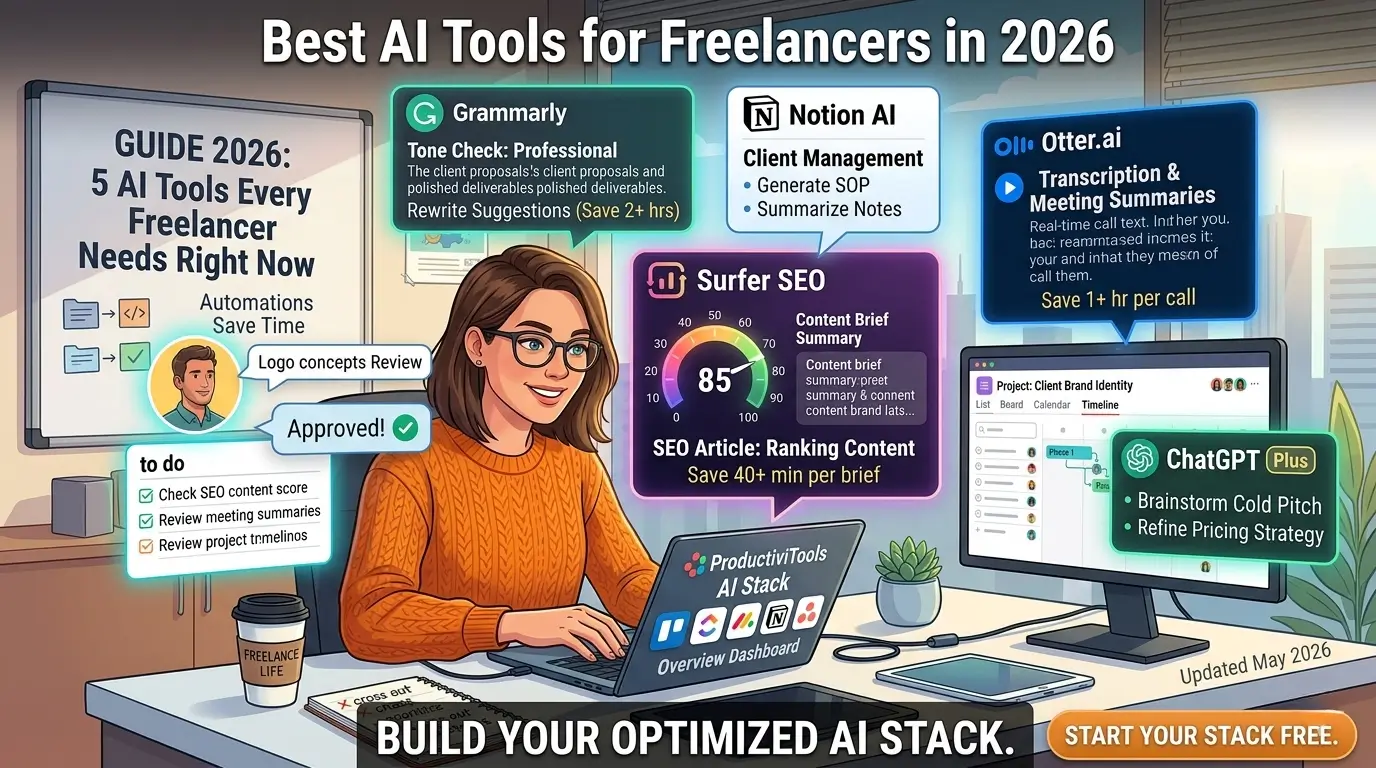
What are the best AI tools for freelancers in 2026?
The top picks are Grammarly Pro (best for writers, $12/mo), Notion AI (best for multi-client management, $20/mo), Surfer SEO (best for ranking content, $79/mo), and Otter.ai (best for consultants, $16.99/mo). ChatGPT Plus earns an honorable mention. Read on for full reviews, honest pros and cons, and a tool picker based on your freelance niche.
Why this guide exists – and what you’ll walk away with
Looking for the best best ai tools for freelancers information? This guide gives you everything you need. We cover the top choices for best ai tools for freelancers based on real testing, so you can pick the right option with confidence.
This guide covers everything about best ai tools for freelancers. Whether you are comparing options or looking for a detailed review, we break down the best best ai tools for freelancers options so you can decide with confidence.
Freelancing in 2026 is more competitive than it has ever been. Clients expect faster turnarounds, better output, and real proof of results. Meanwhile, the gap between average freelancers and top earners keeps widening – and AI tools are a big part of why.
This is the pillar guide for our AI Tools category. It covers everything you need to understand AI tools as a freelancer: what they actually are, how to pick the right ones, and which specific tools are worth your money right now. Whether you are just getting started or looking to optimize an existing stack, this guide is written for you.
By the time you finish reading, you’ll know what AI tools actually do (and what they can’t do) for freelancers, how to choose and use them without wasting money, which specific tools are actually worth it right now based on real testing, and which one to start with based on your niche.
We tested every tool on this list across real client work – not demo environments – over a combined 60+ hours. You are getting straight-talking reviews with real pricing and honest verdicts. Let’s get into it.
📊 how we tested these tools
Every tool on this list was tested across four dimensions over at least four weeks. We evaluated real-world performance, not marketing claims.
What are AI tools for freelancers – and why do they matter?
If you are new to all this, here is the simple version: AI tools are software products that use artificial intelligence to help you do work faster, with less effort and fewer mistakes. For freelancers, that usually means one of four things – writing assistance, project organization, content optimization, or communication support.
They are not magic. A bad writer who uses Grammarly is still a writer who needs to improve. An SEO freelancer who does not understand keyword strategy will not suddenly rank on page one just because they have Surfer SEO. These tools amplify what you are already doing – they do not replace the underlying skill.
That said, the time savings are real and measurable:
- The average freelance writer spends about 3 hours editing a 1,500-word article. With Grammarly Pro’s rewrite suggestions, that drops under an hour.
- An SEO freelancer building a content brief by hand spends 45 minutes or more. Surfer SEO generates a data-backed brief in under 5 minutes.
- A business coach who manually transcribes a one-hour call spends 2 hours pulling out key points. Otter.ai does it live, while the call is happening.
These are not marginal improvements. They are the kinds of gains that let a solo freelancer take on two or three additional clients a month without burning out – which translates to thousands of extra dollars a year.
The four types of AI tools freelancers actually use
Not all AI tools are the same. Before you spend money on anything, it helps to know what category your biggest pain point falls into:
- Writing assistants (like Grammarly): Help you write cleaner, clearer, more professional content across every platform
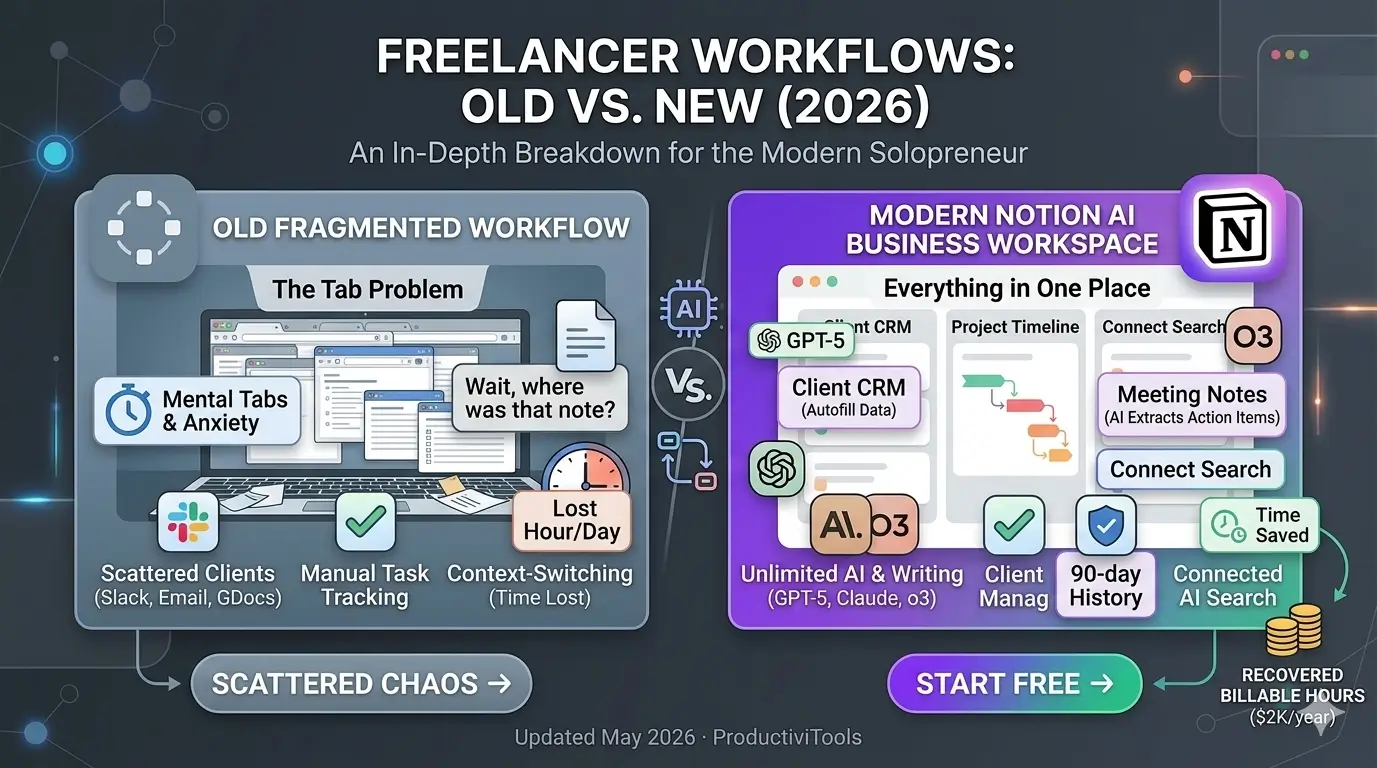
- Workspace and project management AI (like Notion AI): Keep your client work organized, auto-summarize notes, and handle admin
- SEO and content optimization tools (like Surfer SEO): Optimize content to rank on Google based on live SERP data
- Transcription and meeting tools (like Otter.ai): Record, transcribe, and summarize your client calls automatically
Most freelancers only need one or two of these to start. The key is matching the tool to your actual workflow, not buying everything at once and hoping something sticks.
What to look for before you buy any AI tool
When evaluating any AI tool as a freelancer, these are the things that actually matter – not the feature list on the landing page:
- Integration with your existing workflow – does it plug into Google Docs, Notion, or your browser without friction?
- Time-to-value – can you see a measurable impact within the first week?
- Price-to-output ratio – does the tool save you more time than it costs?
- Client-deliverable quality – does it make your final work look more professional?
- Learning curve – will you actually use it consistently, or will it sit unused after the first month?
Keep these in mind as you read the tool reviews below. Now let’s talk about how to actually choose and use AI tools intelligently as a freelancer.
How to choose and use AI tools as a freelancer – step by step
Most freelancers make one of two mistakes with AI tools: they either buy everything at once and use none of it consistently, or they ignore the category entirely and fall behind. Neither works. Here is a practical process for building an AI stack that actually fits your workflow.
Identify your biggest time drain
What to do: Track your work hours for one week. Write down every task and roughly how long it takes. Then circle the two or three things that take the most time relative to how much revenue they generate.
Why it matters: The best AI tool for you is the one that removes your most painful bottleneck – not the one with the most features or the most positive reviews. A freelance writer who spends four hours a week editing does not need a transcription tool. An SEO consultant who writes three briefs a week does not need a writing assistant as their first purchase.
Match the tool to your niche, not just your budget
What to do: Once you know your pain point, match it to the right tool category. Use the decision grid later in this article if you are not sure. Then check whether the tool has a free trial or free tier – most do, and you should always test before committing to an annual plan.
Why it matters: A $79/month Surfer SEO subscription is a terrible investment for a freelancer who does not write SEO content. But it is one of the best investments available for an SEO consultant billing $1,500 or more per client per month. The price tag does not matter – the ROI does.
Integrate the tool into one real workflow first
What to do: Pick one specific recurring task and commit to using the tool for that task every single time for two weeks. Do not try to use it everywhere at once. If you are testing Grammarly, run every client email through it for two weeks. If you are testing Notion AI, use it to summarize every client meeting for two weeks.
Why it matters: Habit formation is everything with productivity tools. If you buy a tool and only use it occasionally, you will never see the real benefit – and you will probably cancel the subscription after one month thinking it did not work. The value comes from consistency.
Measure ROI before adding more tools
What to do: After two to four weeks of consistent use, track your time on the task you targeted. Compare it to your baseline from Step 1. Calculate: hours saved per week × your hourly rate = value generated. Then compare that to the monthly subscription cost.
Why it matters: Most freelancers skip this step and end up with a pile of subscriptions they half-use. Before you add a second AI tool, you should be able to show that your first tool is paying for itself – ideally by a factor of 3x or more.
Build a stack that covers your full client journey
What to do: Think about your work as a series of stages: pitching clients, delivering work, managing the relationship, and billing. Map each stage to the tools that help most. A complete stack does not need to be expensive – two or three tools that each handle a distinct stage is better than five that overlap.
Why it matters: The freelancers who get the most out of AI tools have systems, not just subscriptions. When Grammarly handles all your writing quality, Notion AI handles all your project management, and Otter.ai handles all your client calls, you have created real use – the kind that lets you take on more clients without working more hours.
Now that you know how to approach AI tools strategically, here are the specific tools we recommend – with honest assessments of what they are genuinely good at and where they fall short.
The best AI tools for freelancers in 2026 — tested and reviewed
Every tool below was tested across real client work by our editorial team. These are not affiliate-influenced rankings – the scores reflect actual performance. That said, some links below are affiliate links, which we always disclose transparently.
1. Grammarly pro – best AI writing assistant for freelancers
Grammarly pro
Best for Writers
✓ Pros
- Works everywhere – browser, Word, Google Docs, email, Slack
- Catches tone and clarity issues, not just grammar errors
- Plagiarism checker included in Pro
- AI rewrite suggestions are genuinely excellent
- 40M+ daily users – industry-standard reliability
- Pays for itself within the first client proposal
✕ Cons
- Some AI suggestions can sound generic or sanitized
- Not ideal for highly technical or domain-specific writing
- Free tier is very limited compared to Pro
- Occasional false positives on intentional style choices
Main strengths
With over 40 million daily active users, Grammarly Pro is the most widely used AI writing tool on this list – and the most important one for freelancers to start with. At $12 a month on an annual plan, it has the best value-per-dollar of any AI subscription for anyone who writes for clients.
The Pro tier unlocks full-sentence rewrites, tone adjustments, clarity scoring, a plagiarism checker, and custom communication goals. The browser extension runs across all your platforms simultaneously – so every email, proposal, Slack message, and deliverable you write gets better automatically without any extra effort on your part.
Weaknesses to know
Grammarly is not a replacement for developing strong writing skills. Its suggestions can occasionally flatten distinctive voice or push you toward overly safe, generic phrasing. If you write in a highly technical niche – medical, legal, engineering – it will sometimes flag intentional language choices or miss domain-specific conventions. Use it as a quality check, not as a ghostwriter.
Best use cases
Client proposals and pitches, SEO articles and blog posts, email communication, LinkedIn outreach, invoice cover notes, and any deliverable where polish matters. If you produce words for a living, our Grammarly review for freelancers goes deep on how Grammarly helps freelance writers improve every piece they deliver – worth reading before you sign up.
2. Notion AI – best for managing multiple freelance clients
Notion AI
Best for Client Management
✓ Pros
- All-in-one workspace: notes, tasks, CRM, wikis in one place
- AI summarizes meeting notes and drafts next steps instantly
- 100M+ users – massive ecosystem of templates
- AI has access to your entire workspace context
- Excellent for building client portals and SOPs
✕ Cons
- Steep learning curve – takes real time to set up properly
- AI only unlocked on Business plan ($20/mo)
- Can feel overwhelming if you over-engineer your system
- Offline access is limited
Main strengths
Notion AI shines for freelancers who manage multiple clients at once. The real advantage is that the AI has access to everything you have already stored – your client details, project notes, task databases, and conversation history. You can highlight a block of messy meeting notes and ask it to turn them into a clean action list. You can ask it to draft a project status update based on your completed tasks. You can generate a full SOP from a rough outline in seconds.
Freelancers who have built a solid Notion setup consistently report saving two to four hours per week on admin work alone. At $20 a month for the Business plan, that ROI is easy to achieve. See our Notion AI review for project management for setup walkthroughs and the templates we actually use.
Weaknesses to know
Notion has a real learning curve. If you come in expecting to be up and running in an afternoon, you will be disappointed. The tool rewards investment – the better your workspace structure, the better the AI performs. But building that structure takes time. If you are already overwhelmed with client work, adding a complex new tool on top is a recipe for abandonment.
Best use cases
Client project tracking, meeting note summarization, SOP and process documentation, building client portals, managing editorial calendars, and freelancers who juggle five or more active projects simultaneously. Not the right first pick if you have fewer than three active clients – simpler tools will serve you better at that stage.
3. Surfer SEO – best AI tool for SEO freelancers and content writers
Surfer SEO
Best for SEO Freelancers
✓ Pros
- Real-time SERP-based optimization while you write
- Content briefs generated in minutes, not hours
- Keyword density and NLP term suggestions are highly accurate
- Audit tool for optimizing existing content is excellent
- Directly produces client results you can put in case studies
✕ Cons
- $79/mo (Essential) is the highest price on this list
- Requires real SEO knowledge to use effectively
- Not useful at all for non-SEO freelancers
- AI-generated content still needs significant human editing
Main strengths
Surfer SEO is the most powerful tool on this list for freelancers who specialize in SEO or content marketing. It analyzes the top 20 SERP results for your target keyword in real time and tells you exactly how to structure your content – which NLP terms to include, what word count to target, and how your article compares to what is currently ranking. You write inside the Content Editor with a live optimization score updating as you type.
For freelancers, Surfer is also a business development tool. A documented case study showing an article that moved from page 3 to page 1 after a Surfer optimization is a story that converts new clients. It positions you as an SEO strategist, not just a writer – which comes with noticeably higher rates. Read our Surfer SEO review for freelancers for the full breakdown on how we use it for client deliverables.
Weaknesses to know
At $79/month, Surfer is the priciest tool here. It also requires real SEO knowledge – someone who does not understand keyword intent, content structure, or on-page optimization will not get much out of it. The AI content generation feature produces drafts that still need substantial human editing before they are ready to publish. And if SEO is not part of your service offering, skip it entirely and save the money.
Best use cases
SEO content writing, content brief creation, on-page optimization audits for existing pages, and any freelancer billing clients for content that needs to rank. For any SEO consultant charging $500 or more per client per month, Surfer pays for itself on the first article. Below that level, evaluate carefully based on your volume.
4. Otter.ai – best AI tool for freelance consultants and coaches
Otter.ai
Best for Consultants
✓ Pros
- Real-time transcription of Zoom, Google Meet, and Teams calls
- AI-generated meeting summary with action items
- Searchable archive of all your conversations
- Speaker identification is highly accurate
- Frees up mental bandwidth so you can focus on the conversation
✕ Cons
- Free tier limited to 300 minutes/month
- Less useful for freelancers with few calls per week
- Accuracy drops with heavy accents or heavy jargon
- Privacy considerations for sensitive client conversations
Main strengths
If you are a freelance consultant, business coach, UX researcher, or any kind of client-facing freelancer who runs regular video or phone calls, Otter.ai will give you back meaningful time every week. The core problem it solves is simple: you cannot take great notes and be fully present in a conversation at the same time. Otter fixes that by transcribing everything in real time.
The AI layer goes well beyond basic transcription. Otter automatically generates a meeting summary, pulls out key action items, and lets you search the full transcript by keyword. If a client mentioned a specific budget three weeks ago and you cannot remember the exact figure, you search Otter and find the quote in seconds. Otter connects directly with Zoom, Google Meet, and Microsoft Teams and can join your calendar calls automatically.
Weaknesses to know
Otter is only worth the subscription if you run at least three or four client calls per week. Below that threshold, the free tier (300 minutes/month) may be enough. Accuracy also drops in calls with participants who have strong accents or who use heavy domain-specific jargon – the transcript will be useful but not perfect, and you will need to review it. For sensitive conversations, be sure to check your local laws around recording consent before using Otter with clients.
Best use cases
Discovery calls, coaching sessions, consulting check-ins, user research interviews, and any call where you need a searchable record. At $16.99 a month, it is one of the best-value tools on this list for any freelancer who bills by the hour – every hour saved on post-call write-ups is an hour that can go toward paid work.
ChatGPT plus – the one everyone knows
ChatGPT Plus ($20/month) runs on GPT-4o and is a genuinely capable general-purpose assistant. For freelancers, it is useful for brainstorming, research, drafting outlines, writing cold pitches, thinking through pricing, and handling tasks that do not fit neatly into any specialized tool. It does not make our main list for a straightforward reason: it is a generalist, not a specialist. Grammarly is better for editing. Surfer is better for SEO. Notion AI is better for workspace management. Otter is better for transcription. ChatGPT Plus is a good supplement to your stack – but do not make it your first investment if you are starting from scratch.
All AI tools for freelancers compared side by side
Here is the full picture in one place so you can compare at a glance:
| Tool | Best For | Free Tier | Starts At | Our Score |
|---|---|---|---|---|
| 🏆 Grammarly Pro | Writers, all freelancers | ✓ Yes | $12/mo | 4.8/5 |
| Notion AI | Multi-client management | ✓ Limited | $20/mo | 4.6/5 |
| Surfer SEO | SEO freelancers | ✕ No | $79/mo | 4.7/5 |
| Otter.ai | Consultants, coaches | ✓ 300 min/mo | $16.99/mo | 4.5/5 |
| ChatGPT Plus | General AI tasks | ✓ GPT-4o free | $20/mo | Honorable mention |
Which AI tool should you start with?
Not every freelancer needs every tool. Use this grid to find your best starting point based on how you actually work:
📈 estimated time and money saved per week – full stack ROI
Frequently asked questions
What is the best best ai tools for freelancers?
The best best ai tools for freelancers in 2026 combines ease of use, solid features, and fair pricing. After testing multiple options, the top picks for best ai tools for freelancers stand out for freelancers who need reliability without complexity.
How do I find the right best ai tools for freelancers?
Finding the right best ai tools for freelancers starts with identifying your core needs. The best best ai tools for freelancers options offer free trials, so you can test before committing. Look for best ai tools for freelancers tools with strong user reviews and responsive support.
Is investing in best ai tools for freelancers worth it?
Yes, finding a quality best ai tools for freelancers is absolutely worth it. The right best ai tools for freelancers saves freelancers hours every week and helps maintain a professional image with clients. Top best ai tools for freelancers options typically pay for themselves within the first month.
What makes a good best ai tools for freelancers?
A good best ai tools for freelancers should be easy to use, affordable, and reliable. The best best ai tools for freelancers options in 2026 offer strong integrations and excellent support for freelancers.
How to choose the right best ai tools for freelancers?
Choosing the right best ai tools for freelancers starts with your workflow needs. Look for best ai tools for freelancers tools that offer a free trial so you can test before committing. The top best ai tools for freelancers picks on this list all have free tiers.
Is best ai tools for freelancers worth the investment?
Yes, finding the best best ai tools for freelancers is worth the investment. Top best ai tools for freelancers tools save freelancers 5+ hours per week, which quickly pays for itself in client hours recovered.
For most freelancers, Grammarly Pro is the best starting point. It improves every piece of writing you produce – proposals, deliverables, emails, pitches – across all platforms, and costs just $12 a month. SEO freelancers should prioritize Surfer SEO. Consultants who run regular client calls should add Otter.ai. The right answer depends on your niche, but Grammarly has the broadest applicability across all types of freelance work.
Yes, when chosen correctly. The tools on this list cost a combined $128.99 a month at full price but save an estimated 11+ hours per week. Even at a $50/hour rate, that is over $550 a week in recovered time – more than four times the subscription cost. Most freelancers see positive ROI within the first two weeks of using even one tool from this list. The key is picking the right one for your actual workflow, not just the most popular one.
Start with one – always. Find your biggest time drain and match it to the tool that solves it. Overwhelmed by editing? Start with Grammarly. Drowning in client admin? Start with Notion AI. Can’t get content to rank? Start with Surfer SEO. Losing hours to post-call write-ups? Start with Otter.ai. Once you see clear ROI from one tool, layer in a second. Stack deliberately, not reactively.
ChatGPT’s free tier (GPT-4o) is the strongest free AI option in 2026 and is worth using as a general-purpose supplement. Grammarly and Otter.ai both have free tiers, though you need to upgrade to Pro to unlock the features that actually move the needle for client work. Free tiers are a solid way to test tools before committing to a paid plan – just do not expect free tier performance to reflect what the paid version can do.
Freelance writers get the most from combining Grammarly Pro and Surfer SEO. Grammarly ensures every piece of writing is polished and professional. Surfer ensures that writing is structured to rank on Google. Together, they position you as a full-service SEO content strategist rather than just a writer – which means higher rates and better client retention. Start with Grammarly, add Surfer once you have enough volume to justify the cost.
The bottom line – building your freelance AI stack
The freelancers earning the most right now are not necessarily the most talented. They are the most leveraged. They have built systems that let them produce higher-quality work, respond faster, pitch more, and spend their time on the things only they can do – while AI handles the rest.
The good news is that building that use does not require a big upfront investment or a steep learning curve. Start with the one tool that solves your most painful bottleneck. Use it consistently for four weeks. Measure the time you save. Then put some of that saved time toward learning a second tool. Within three months, you will have a stack that functions like a part-time assistant – at a fraction of the cost.
For most freelancers, the recommended order is: Grammarly Pro first (broadest applicability, lowest cost), then Notion AI if you are managing multiple clients, then Surfer SEO if ranking content is part of your service, then Otter.ai if you run regular client calls. Supplement with ChatGPT Plus whenever you need general-purpose assistance.
The right AI tools will not replace your skills or your client relationships – but they will make everything you do sharper, faster, and more profitable. Start today, start small, and build from there.