Zapier Review: Is It Worth the Price or Are You Paying for Features You Do Not Need?
Last updated: June 2026
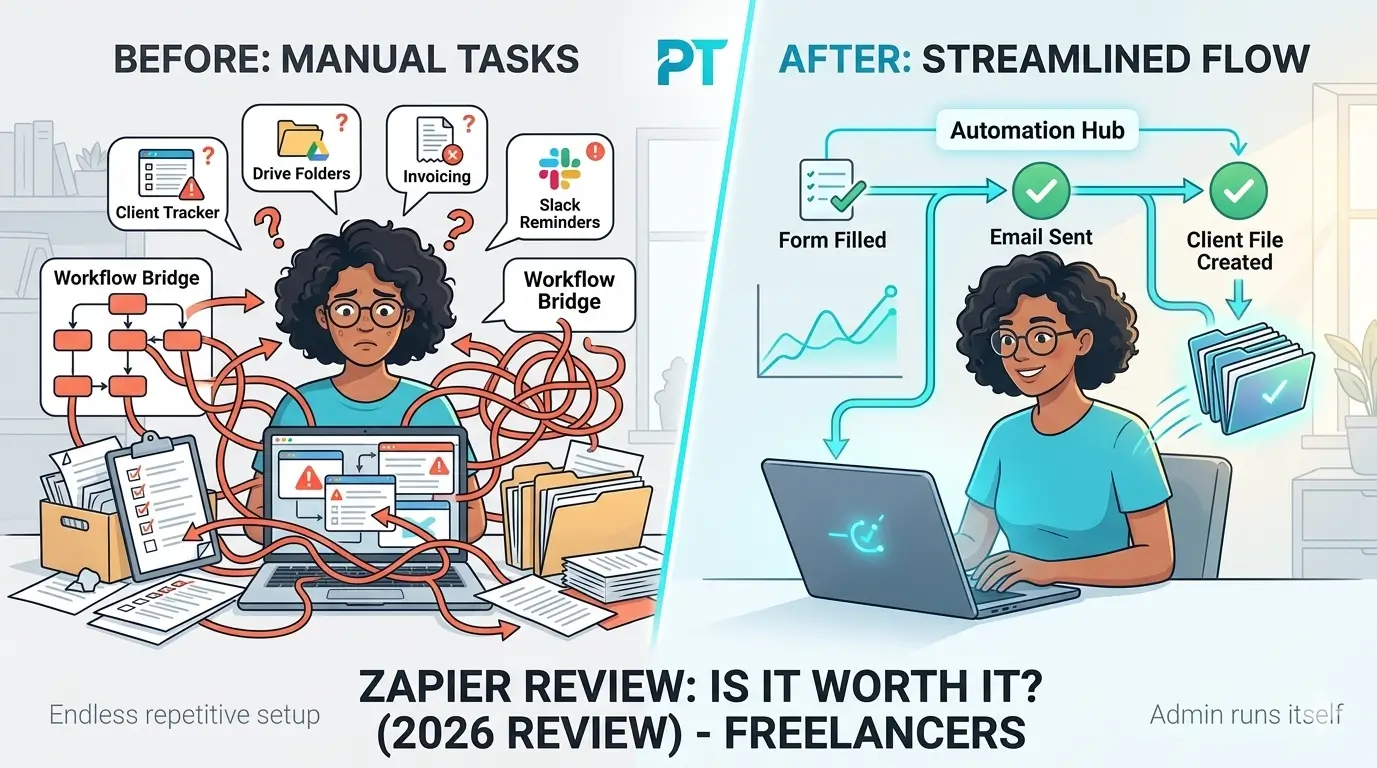
You just landed a new client. You send a welcome email, create a folder in Google Drive, add them to your project tracker, shoot a Slack message to yourself as a reminder, and then update your CRM. By the time you’re done, twenty minutes have evaporated – and you haven’t done a single billable thing yet.
Now multiply that by every new client, every invoice follow-up, every form submission, every social media post you cross-publish manually. That’s where a lot of freelancers quietly bleed time – not in the work itself, but in all the repetitive setup around it.
That’s exactly the problem I was trying to solve when I first found Zapier.
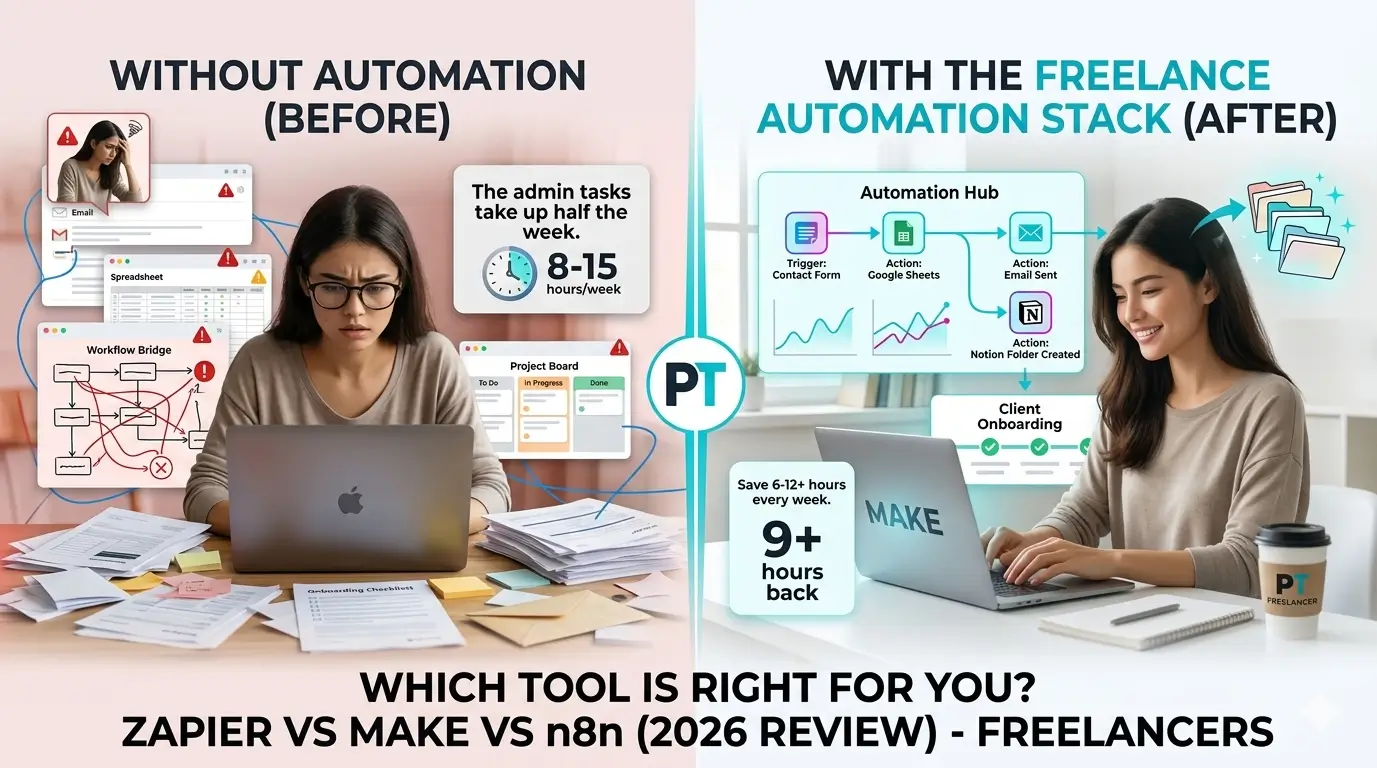
Before automation – the freelancer’s invisible time drain
Looking for the best zapier review for freelancers information? This guide gives you everything you need. We cover the top choices for zapier review for freelancers based on real testing, so you can pick the right option with confidence.
This guide covers everything about zapier review freelancers. Whether you are comparing options or looking for a detailed review, we break down the best zapier review freelancers options so you can decide with confidence.
Running a freelance business solo means wearing every hat. You’re the salesperson, the accountant, the project manager, and the actual person doing the work. And a surprising amount of your day disappears into small, repetitive tasks that feel necessary but don’t move anything forward.
Every new inquiry gets manually copy-pasted into a spreadsheet. Every invoice gets chased by hand. Files end up in the wrong folders because you forgot to sort them. Social posts go live late because you were in the middle of client work. None of it is hard – it’s just endless, and it adds up to hours every week that you’re not getting paid for.
I was at that point. Spending way too much mental energy on logistics, not enough on actual creative work. I needed to offload the repetitive stuff to something that didn’t get tired or distracted. That’s when I started seriously looking at automation tools – and Zapier was the first one I tried.
After automation – what changes when the repetition disappears
Imagine a new client fills out your contact form at 11pm on a Sunday. By the time you wake up Monday morning, they’ve already received your welcome email, their details are in your CRM, a client folder exists in Google Drive, and a follow-up task has been created in your project tracker – all without you touching anything.
That’s not a fantasy. That’s what a well-built automation workflow actually looks like. An invoice goes overdue? A polite reminder goes out automatically. You publish a new blog post? It gets drafted and queued across your social channels without you lifting a finger.
The shift isn’t just about saving time. It’s about getting your evenings back, stopping things from slipping through the cracks, and being able to take on more clients without proportionally more overhead. When the admin runs itself, you get to focus on the part of the work that actually matters.
Enter Zapier – the tool that promises to glue everything together
Zapier has been around since 2011 and is genuinely the best-known automation tool in the market. It connects over 6,000 apps – Gmail, Notion, Trello, Stripe, Typeform, HubSpot, Calendly, and hundreds more – and lets you build automated workflows between them without writing a single line of code.
The core idea is simple: something happens in one app (a trigger), and Zapier automatically does something in another app (an action). Fill out a form, and Zapier adds the person to your email list. Receive a payment, and Zapier creates a new project in your tracker. The whole thing runs in the background while you do literally anything else.
I used it through most of 2024, built real workflows for client onboarding and invoice follow-ups, and learned where it shines and where it starts to frustrate you. This review is based on that actual experience – not a trial run, not a demo. Here’s my honest take.
Take a look at our automation tools guide – a full roundup of the best automation tools for freelancers in 2026, tested and ranked. Or if you’re specifically deciding between Zapier and Make, see how Zapier compares to Make in our head-to-head breakdown.
Quick summary: Zapier review for freelancers
Zapier at a glance
3.8 / 5
Beginners to automation, freelancers who need a specific niche integration
Free (very limited) – $19.99/mo Starter – $49/mo Professional
Easiest setup in the market, 6,000+ integrations, rock-solid reliability
Expensive for what you get, free tier is too limited, complex logic is clunky
5/5
5/5
4/5
2/5
3/5
5/5
My real experience with Zapier
Getting started – faster than expected
I signed up on a Wednesday afternoon expecting to spend most of the day figuring things out. I had my first Zap live in about twelve minutes. That’s not an exaggeration – Zapier walks you through the whole process step by step. Pick a trigger app, choose the event, connect your account, then do the same for the action side. There’s no guesswork, no blank canvas staring back at you. It’s genuinely the most beginner-friendly automation tool I’ve used.
The template library helped a lot. I found a template for “save Gmail attachments to Google Drive” that was almost exactly what I needed, tweaked it slightly, and had it running in minutes. That kind of early win matters – it makes you want to build more, and it shows you what’s actually possible before you’ve invested a lot of time.
Day-to-Day use – smooth, until it isn’t
For simple, linear automations, Zapier is excellent. I built a client onboarding sequence – contact form submission triggers a welcome email, adds the person to my CRM, and creates a Google Drive folder – and it ran without issues for months. Every time a new lead came in, everything happened automatically. That alone saved me probably two hours a week.
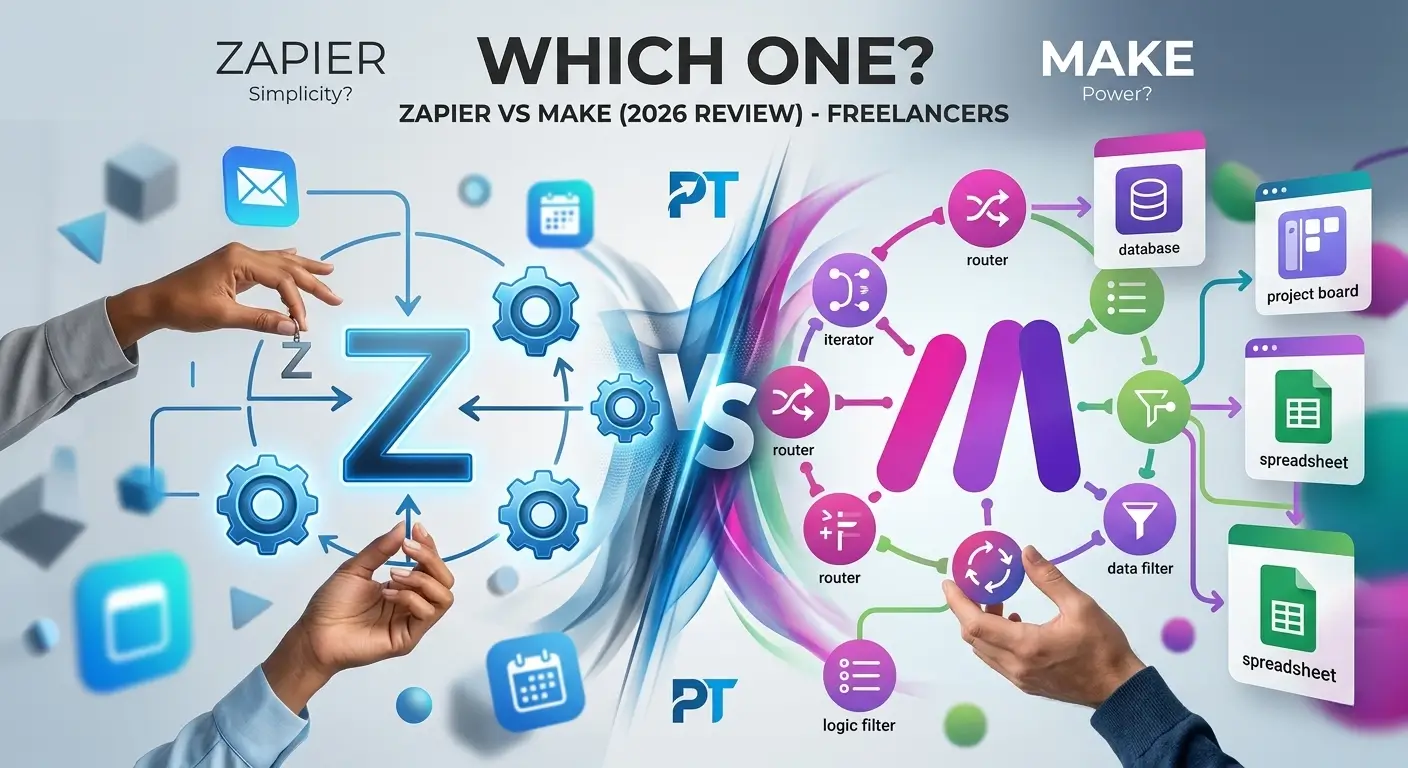
The friction showed up when I tried to get more sophisticated. I wanted to route different types of clients through different onboarding flows depending on what service they selected in the form. In Make, that’s a built-in router on a visual canvas. In Zapier, you have to use the “Paths” feature, which is only available on the Professional plan and involves setting up conditional branches that quickly become hard to follow and maintain. Not impossible, but noticeably more annoying than it needs to be.
Performance and reliability
Here’s where Zapier genuinely earns its stripes. It almost never goes down. My Zaps ran when they were supposed to, and in the rare cases where something failed – usually because an API on the other app had a hiccup – Zapier notified me immediately and let me replay the failed tasks. I never lost data. I never had workflows silently stop working without knowing about it. For reliability, Zapier is genuinely top tier.
The task counter – a constant presence
On the Professional plan at $49/month, you get 2,000 tasks. That sounds like a lot until you realize that every step in a Zap counts as one task. A three-step automation that runs 200 times a month burns through 600 tasks on its own. Run a handful of active workflows and you’re watching that counter closely by week three. I upgraded my plan once just because a busy month burned through my allocation. That’s not a great feeling when you’re already paying $49 for the privilege.
Practical insights from months of use
A few things I wish someone had told me before I started: always test your Zap with real data before you let it run live, because the “sample data” in the setup wizard sometimes behaves differently than actual incoming data. Also, if you’re building more than a handful of Zaps, name them properly from day one – coming back to a workflow called “Zap 7” three months later and trying to figure out what it does is not fun. And audit your active Zaps every couple of months, because you’ll inevitably have workflows running that you forgot about and no longer need, quietly eating your task allocation.
Pricing – the honest breakdown
Honestly, this is where most people’s enthusiasm for Zapier cools down. The pricing structure is aggressive relative to what you actually get, especially at the lower tiers. We think the free plan is actively misleading – 100 tasks and 5 Zaps sounds like a real offer, but in practice it lasts about a week before you hit the ceiling.
| Plan | Price | Zaps | Tasks/mo | Verdict |
|---|---|---|---|---|
| Free | $0 | 5 Zaps | 100 tasks | Too limited |
| Starter | $19.99 /mo | 20 Zaps | 750 tasks | Overpriced |
| Professional Best Zapier Plan | $49 /mo | Unlimited | 2,000 tasks | Worth it if you must use Zapier |
| Team | $69 /mo | Unlimited | 2,000 tasks | Not for freelancers |
If you’re going to use Zapier seriously, the Professional plan at $49/month is the one that actually makes sense – unlimited Zaps, multi-step workflows, and conditional paths. But that’s $588 a year. For comparison, Make’s Core plan starts at $9/month and handles most of what the Professional plan does, with more visual flexibility on top. The math is hard to argue with.
Workflows freelancers actually use
Before you commit to any paid plan, it helps to know whether Zapier actually fits your day-to-day. These are the automations that work best in Zapier – simple, reliable, and genuinely useful for solo freelancers.
New form submission triggers a welcome email, adds the lead to your CRM, and creates a follow-up task automatically. Set it up once and forget it.
HubSpot
Gmail
When a new project kicks off, automatically create a structured folder in Google Drive and share it with the client. No more manual setup every time.
Google Drive
Gmail
Publish a blog post and watch Zapier automatically draft it across your social channels. Hours saved, every single week, without touching a second screen.
Buffer
Overdue invoice triggers a polite follow-up email and logs the event in a spreadsheet. Chasing payments without the awkward manual nudge.
Gmail
Google Sheets
What Zapier gets right
No tool is all bad or all good – and Zapier genuinely does a few things better than anything else on the market right now.
- The easiest setup of any automation tool. If you’ve never automated anything, you’ll have your first workflow running in under 15 minutes. No learning curve, no confusion, no staring at a blank screen.
- Over 6,000 integrations. This is Zapier’s strongest card. Almost every SaaS tool a freelancer uses is in there, and the list keeps growing.
- Thousands of pre-built templates. Find something close to what you need, clone it, tweak it, and you’re live. It dramatically lowers the barrier to getting started.
- Rock-solid reliability. Zaps run when they’re supposed to. When something fails, Zapier tells you and lets you replay it. You can genuinely set things and forget them.
- Great documentation and support. Clear guides, active community, and responsive support. When you get stuck, there’s usually an answer within a few clicks.
Where Zapier falls short
Being honest about the downsides is the only way to help you make a real decision – so here’s what I’d want to know before paying for Zapier.
- The free plan is basically a demo. Five Zaps and 100 tasks a month sounds fine until you actually try to run real workflows. Most active freelancers blow past that in the first week.
- The pricing is hard to justify. $49/month for 2,000 tasks is steep when alternatives like Make offer similar functionality for a fraction of that cost.
- Task limits creep up on you. Every step in a multi-step Zap counts as a separate task. Active workflows with moderate usage can eat 2,000 tasks faster than you’d expect.
- Complex logic is clunky. Conditional branching (if/then routing) exists, but it requires the Professional plan and feels awkward to build and maintain compared to Make’s visual canvas.
- Multi-step workflows are paywalled. You can’t build useful, real-world automations on the free or Starter tiers. The tool only becomes genuinely functional at $49/month.
What Works
- Easiest setup of any automation tool
- 6,000+ integrations – widest available
- Thousands of ready-made templates
- Rock-solid reliability and uptime
- Excellent documentation and support
What Doesn’t
- Free tier is too limited for real use
- Paid plans are expensive vs. competitors
- Task limits are easy to blow through
- Complex logic is clunky vs. Make
- Multi-step workflows locked behind paywall
Who should use Zapier
Zapier is a genuinely good fit if you’re new to automation and want the most guided, beginner-friendly experience available. Use the free plan, build two or three simple workflows, and see what automation actually feels like in practice. You’ll learn more in a week of hands-on use than from any tutorial.
It also makes sense if your freelance stack includes a tool that Make doesn’t support yet. With 6,000+ integrations, Zapier covers a lot of niche apps and platforms that smaller automation tools haven’t added. If your workflow depends on one of those, Zapier might be your only practical option. And if a client or employer is already covering the cost of a Zapier account, there’s no reason to switch – stick with what works.
Who should skip Zapier
If you’re already comfortable with technology and not intimidated by a slightly steeper learning curve, you’ll outgrow Zapier’s pricing model before you outgrow its features. The Professional plan at $49/month is hard to justify when Make’s Core plan at $9/month does most of the same things and actually handles complex logic more gracefully.
If you’re running a solo freelance business on a budget, the math just doesn’t work out in Zapier’s favor. And if you eventually want to build workflows with real decision-making – routing different client types through different processes, running automations that adapt based on data – Make’s visual canvas will serve you much better in the long run. You’d be paying a premium for simplicity you’ll eventually stop needing.
Alternatives worth considering
Zapier isn’t the only option, and depending on your situation, one of these might be a better fit from day one.
Make
The most direct competitor. Make handles complex, multi-step workflows on a visual drag-and-drop canvas, supports conditional logic natively, and starts at $9/month – a fraction of Zapier’s Professional plan price. The learning curve is steeper, but most freelancers find it manageable. If you’re willing to spend an extra hour learning, Make is almost always the smarter financial choice. Make is worth checking out – we reviewed it in depth and the value is hard to beat.
n8n
An open-source automation tool with a free self-hosted option. Highly flexible and powerful, but requires more technical setup. If you’re comfortable with servers and want total control over your data, n8n is worth exploring. Not the right starting point for most freelancers, but excellent for those who want to go deep.
Pabbly connect
A budget-friendly alternative with a one-time lifetime pricing option. Fewer integrations than Zapier, but if cost is a primary concern and your tools are covered, Pabbly is worth a look. Less polished than the big two but functional for straightforward workflows.
Final verdict
Great tool to start with – hard to justify long-term
Zapier is genuinely excellent at what it does. The ease of use is unmatched, the integration library is the best in the market, and it almost never goes down. If you’re just getting started with automation, it’s a fantastic place to learn what’s possible and build real habits around automating your work. But once you’re using it regularly and the bills start stacking up, the value equation gets uncomfortable. Make does most of the same things – and more complex things – at a fraction of the price. Unless you’re locked into a Zapier-only integration or you genuinely need the simplest possible interface, switching to Make is a decision most freelancers don’t regret.
Ready to try automation?
If you want to test automation without committing anything, Zapier’s free plan is a perfectly valid starting point – five Zaps and 100 tasks is enough to understand how it works and get a feel for what it can do for your freelance workflow. No credit card needed to start.
If you’re already leaning toward something more cost-effective, our automation tools guide for freelancers covers the full space – including which tool is likely the best fit depending on your situation. And if you want a direct comparison before deciding, see how Zapier compares to Make in our side-by-side breakdown. Either way, getting started with automation is one of the best investments you can make in your solo business.
For more details, check out Zapier to explore all available options for freelancers.
Frequently asked questions
What is the best zapier review for freelancers?
The best zapier review for freelancers in 2026 combines ease of use, solid features, and fair pricing. After testing multiple options, the top picks for zapier review for freelancers stand out for freelancers who need reliability without complexity.
How do I find the right zapier review for freelancers?
Finding the right zapier review for freelancers starts with identifying your core needs. The best zapier review for freelancers options offer free trials, so you can test before committing. Look for zapier review for freelancers tools with strong user reviews and responsive support.
Is investing in zapier review for freelancers worth it?
Yes, finding a quality zapier review for freelancers is absolutely worth it. The right zapier review for freelancers saves freelancers hours every week and helps maintain a professional image with clients. Top zapier review for freelancers options typically pay for themselves within the first month.
What makes a good zapier review freelancers?
A good zapier review freelancers should be easy to use, affordable, and reliable. The best zapier review freelancers options in 2026 offer strong integrations and excellent support for freelancers.
How to choose the right zapier review freelancers?
Choosing the right zapier review freelancers starts with your workflow needs. Look for zapier review freelancers tools that offer a free trial so you can test before committing. The top zapier review freelancers picks on this list all have free tiers.
Is zapier review freelancers worth the investment?
Yes, finding the best zapier review freelancers is worth the investment. Top zapier review freelancers tools save freelancers 5+ hours per week, which quickly pays for itself in client hours recovered.