Zapier vs Make: Which One Saves Freelancers More Time (and Money)?
Last updated: June 2026
You’ve been going back and forth for days. Zapier or Make? Every comparison you read seems to say something different. One article says Zapier is simpler. Another says Make is way more powerful. A third one tells you the pricing is totally different but then glosses over the details. You just want a straight answer so you can stop overthinking it and actually start automating your work.
Here’s the thing: this decision matters more than it looks. Not because one tool will ruin your freelance business, but because the wrong pick means you’ll either overpay every month, hit a ceiling when you need to do something complex, or spend weeks learning a tool that doesn’t fit how you actually work.
Why picking the wrong tool is a real problem
Looking for the best zapier vs make for freelancers information? This guide gives you everything you need. We cover the top choices for zapier vs make for freelancers based on real testing, so you can pick the right option with confidence.
This guide covers everything about zapier vs make freelancers. Whether you are comparing options or looking for a detailed review, we break down the best zapier vs make freelancers options so you can decide with confidence.
Imagine you go with Zapier because it looks cleaner. You build a few automations, things work fine – and then your monthly bill starts climbing as your workflows grow. You realize the plan you need costs $49/month, and you’re still hitting limitations on what your automations can do. Suddenly you’re spending almost $600 a year on a tool that’s holding you back.
Or you go with Make because someone said it’s more powerful. You open the app, stare at the visual canvas, and feel immediately lost. You spend a weekend trying to figure it out, get frustrated, and end up not automating anything at all. The tool was great – but it wasn’t the right starting point for you.
Both of these situations are completely avoidable. You just need an honest comparison that doesn’t sugarcoat the tradeoffs.
The real cost of getting this wrong
Automation tools aren’t a one-time purchase. You’re choosing a platform you’ll be using, paying for, and building on top of for years. A $10/month difference doesn’t sound dramatic until you’ve paid it for three years and realize you’ve spent $360 more than you needed to. And if you build 15 automations in the wrong tool and then decide to switch, you’re rebuilding everything from scratch.
I’ve used both Zapier and Make extensively for real freelance work – client onboarding, invoice follow-ups, content scheduling, lead routing. Not just for the sake of writing this article, but because automation is genuinely how I manage a solo business without losing my mind. What follows is the most direct comparison I can give you, without the fluff.
Check out our full guide: Best Automation Tools for Freelancers in 2026 – 5 tools tested and ranked with hands-on scores.
At a glance
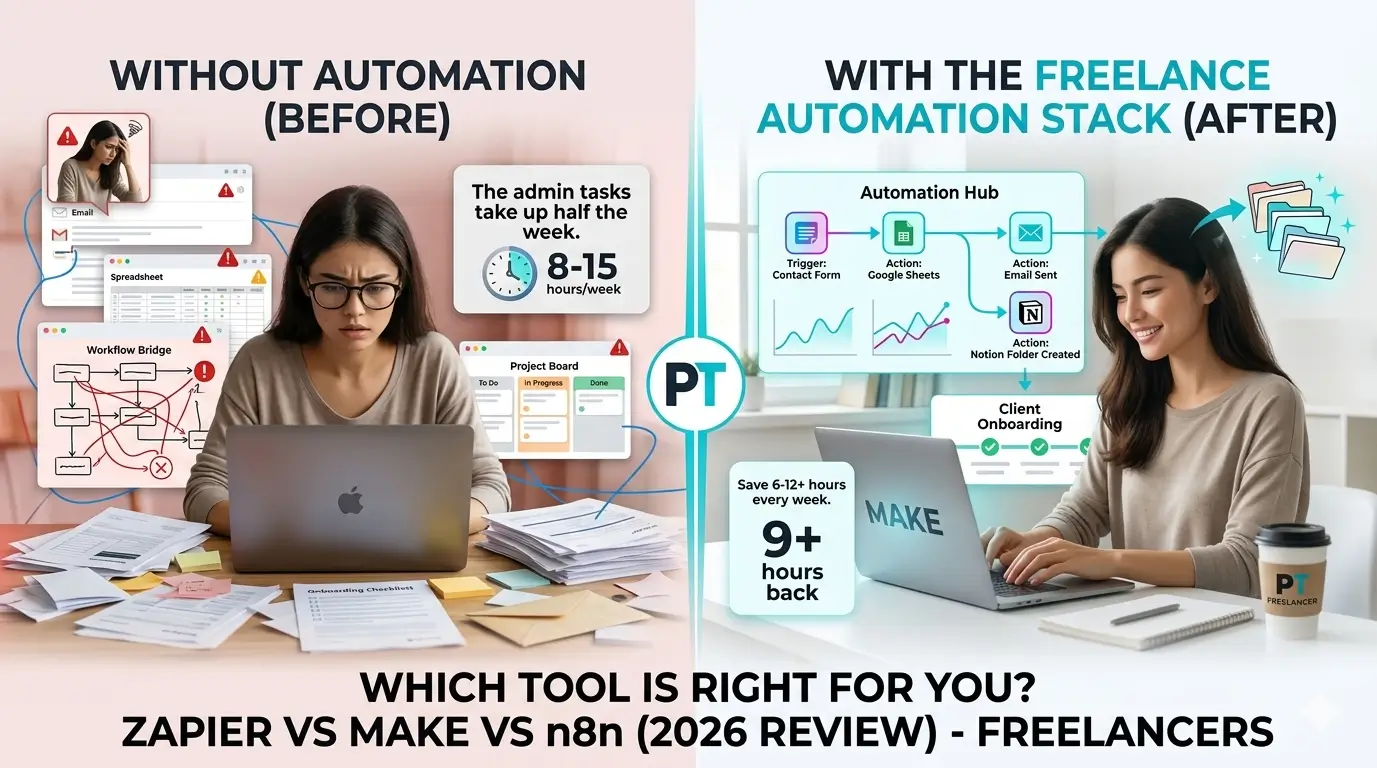
Before we dig into the detail, here’s the high-level picture. Both tools do the same fundamental thing – they connect your apps and run tasks automatically. But they’re quite different in approach, price, and how powerful they get.
Best for true beginners
Best overall value
Make wins for most freelancers. It’s more powerful, handles complex workflows far better, and costs less than half of what Zapier charges. The only real reason to go with Zapier is if you’ve never touched automation before and want the simplest possible start – or if a specific integration you need isn’t in Make yet. For everyone else, Make is the smarter pick.
Feature-by-feature breakdown: Zapier vs Make for freelancers
Here’s how each tool holds up on the things that actually matter for running a freelance business.
| Category | Zapier | Make |
|---|---|---|
Ease of Use How fast can a beginner build their first workflow? | Zapier Wins | – |
Pricing and Value What do you actually get for your money? | – | Make Wins |
App Integrations How many apps can you connect? | Zapier Wins | – |
Free Tier What can you actually do for free? | – | Make Wins |
Workflow Power Can it handle complex, multi-step logic? | – | Make Wins |
Reliability Does it run without breaking? | Tie | Tie |
Features and performance
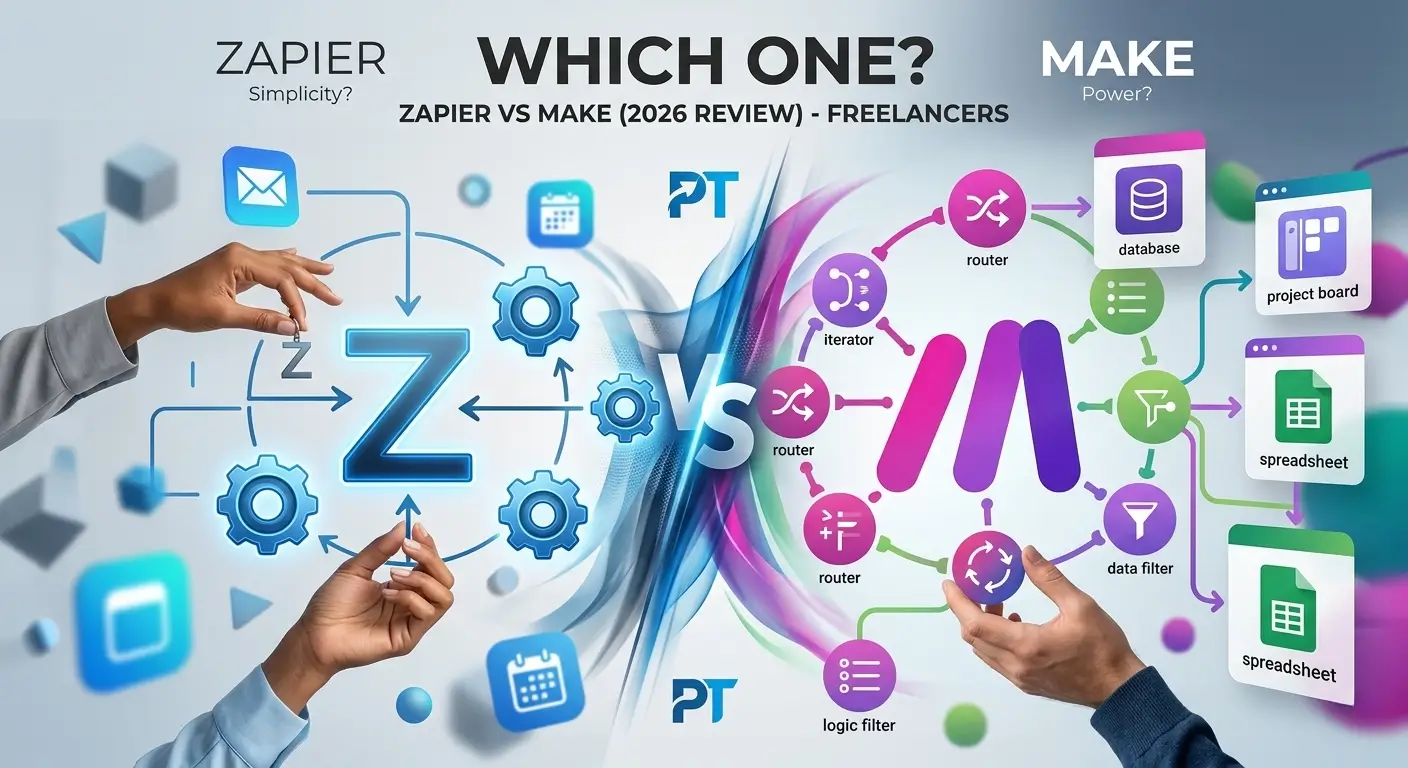
Zapier’s workflow builder is a linear step-by-step wizard. Pick a trigger, pick an action, connect your accounts. Clean and fast. The problem is that the linear structure becomes a limitation as soon as you need anything beyond basic: conditional logic, multiple branches, or looping through a list of items gets messy fast, often requiring multiple separate Zaps that don’t talk to each other cleanly.
Make runs on a visual canvas where you drag modules and connect them like a flowchart. It supports branching, loops, error handling, and data transformation inside a single scenario. For real freelance workflows – like routing leads differently based on their budget, or triggering a sequence of actions when a project reaches a certain stage – Make handles it elegantly. Zapier struggles with the same tasks.
User experience
Zapier’s onboarding is genuinely excellent. Most people get their first automation running in under 10 minutes without reading any documentation. If you’ve never automated anything before, that experience matters.
Make has a steeper first hour. The canvas feels unfamiliar when you’re used to linear tools, and there are concepts (modules, bundles, iterators) that take a bit of time to click. But here’s the honest truth: once those concepts land – which takes most people two to three hours of hands-on work – Make starts to feel more intuitive than Zapier for anything complex. You can see your entire automation at a glance. That visual clarity is something Zapier simply can’t offer.
Pricing
Zapier’s free plan gives you 5 Zaps and 100 tasks per month. That’s barely enough to understand what automation is. Their Starter plan starts at $19.99/month, and the Professional plan – which unlocks multi-step workflows – runs $49/month.
Make’s free plan gives you 1,000 operations per month. Their Core plan is $9/month for 10,000 operations. The Pro plan is $16/month with advanced features like full execution logs and custom variables. Most freelancers land on free or Core and never need to go further.
Integrations
Zapier connects to 6,000+ apps. Make supports around 1,500+. On paper, Zapier wins here and it’s not close. In practice, the gap matters a lot less than you’d think. The apps most freelancers actually use – Gmail, Google Drive, Notion, Trello, Slack, Calendly, Stripe, Typeform, ConvertKit – are all in Make. The extra 4,500 apps Zapier offers are mostly niche business tools you’ll probably never touch. Check Make’s integration list for any specific tools you depend on, but for most freelancers the catalog is more than enough.
Support
Both tools have solid documentation and active communities. Zapier’s support is generally faster for email tickets. Make has an excellent community forum and detailed execution logs that make debugging your own automations much easier. When something breaks, Make’s error handling tools let you see exactly what failed and why – a genuine advantage over Zapier’s more limited error visibility.
Which tool is right for you
The honest answer is that neither tool is universally better. The right pick depends on where you are right now.
Choose Zapier if you are…
- Brand new to automation and want the gentlest possible start
- Running only 2 or 3 simple workflows
- Using a niche app that Make doesn’t support yet
- On a team where Zapier is already the standard
Choose Make if you are…
- Ready to build real workflows with conditions and branching
- Watching your budget – $9/mo beats $49/mo
- Planning to grow your automation setup over time
- Willing to invest two hours learning for long-term payoff
For beginners
If you’ve never automated anything, Zapier is a genuinely welcoming place to start. You’ll get your first automation running in minutes and that momentum matters when you’re learning something new. Once you understand how triggers and actions work, switching to Make later is much easier – the logic is the same, only the interface changes.
For professionals
If you’re already comfortable with automation concepts and you’re building multi-step workflows that need to handle different conditions depending on incoming data, Make is the clear choice. Zapier will eventually feel like a bottleneck. Make won’t.
For teams
Teams working with complex, interconnected workflows will find Make’s visual builder invaluable – it’s much easier to hand off a scenario to someone else when they can see the entire workflow on one canvas. Zapier’s list format gets hard to read once automations reach any real complexity.
For budget-Conscious freelancers
Make wins decisively. The free tier alone gives you 1,000 operations per month – enough to run real automations without paying anything. When you do upgrade, $9/month gets you 10,000 operations. That same capability from Zapier costs $49/month. Over a year that’s nearly $500 saved, with more power to show for it.
Already using Zapier? here’s when to switch
If your Zapier setup is running fine right now, there’s no urgent reason to tear it down and rebuild today. But there are two situations where making the move is clearly worth the effort.
The first is when you keep hitting Zapier’s limits – either running out of tasks on your plan or finding that your workflows can’t do what you need within Zapier’s linear structure. The second is when your Zapier bill starts feeling heavy. If you’re on Professional at $49/month, rebuilding in Make takes a few hours but immediately puts $40/month back in your pocket with no meaningful loss in capability. Over a year, that’s nearly $500 – for a freelancer, that’s real money.
Read our full individual reviews: Zapier Review for Freelancers and Make Review for Freelancers – with workflow walkthroughs and honest takes on what each tool actually delivers.
For more details, check out Zapier to explore all available options for freelancers.
Frequently asked questions
What is the best zapier vs make for freelancers?
The best zapier vs make for freelancers in 2026 combines ease of use, solid features, and fair pricing. After testing multiple options, the top picks for zapier vs make for freelancers stand out for freelancers who need reliability without complexity.
How do I find the right zapier vs make for freelancers?
Finding the right zapier vs make for freelancers starts with identifying your core needs. The best zapier vs make for freelancers options offer free trials, so you can test before committing. Look for zapier vs make for freelancers tools with strong user reviews and responsive support.
Is investing in zapier vs make for freelancers worth it?
Yes, finding a quality zapier vs make for freelancers is absolutely worth it. The right zapier vs make for freelancers saves freelancers hours every week and helps maintain a professional image with clients. Top zapier vs make for freelancers options typically pay for themselves within the first month.
What makes a good zapier vs make freelancers?
A good zapier vs make freelancers should be easy to use, affordable, and reliable. The best zapier vs make freelancers options in 2026 offer strong integrations and excellent support for freelancers.
How to choose the right zapier vs make freelancers?
Choosing the right zapier vs make freelancers starts with your workflow needs. Look for zapier vs make freelancers tools that offer a free trial so you can test before committing. The top zapier vs make freelancers picks on this list all have free tiers.
Is zapier vs make freelancers worth the investment?
Yes, finding the best zapier vs make freelancers is worth the investment. Top zapier vs make freelancers tools save freelancers 5+ hours per week, which quickly pays for itself in client hours recovered.
Final thoughts
Both Zapier and Make are solid, well-maintained tools. If you’re a complete beginner, Zapier’s simplicity is genuinely valuable – don’t let anyone tell you it’s a bad tool, because it isn’t. But when you’re ready to build automations that actually run your business, Make is where you want to be. More power, lower cost, and a free tier that gives you real room to grow before you spend a cent.
The decision doesn’t have to be permanent either. Start wherever feels right, learn the concepts, and move when the time is right. Automation is the kind of skill that pays you back every single day once it’s set up properly – and either of these tools can get you there.